
How to Start Freelancing: A Complete Beginner’s Guide in 2026

Introduction
If you have a useful skill and want to earn money independently, freelancing can be a practical way to start. But knowing how to start freelancing is about more than simply creating an account on a freelance platform. You need to choose a marketable skill, understand what clients need, create examples of your work, set reasonable prices, and learn how to communicate professionally.
The good news is that beginners do not necessarily need years of professional experience before looking for their first client. You can start by developing one specific skill, building a small portfolio, and offering a clearly defined service.
This guide explains how to start freelancing step by step. You will learn how freelancing works, which skills you can offer, how to create a portfolio, where to find clients, how to price your services, how payments work, and which mistakes beginners should avoid.

What Is Freelancing?
Freelancing is a form of independent work where a person provides services to clients without being a permanent employee of one company. A freelancer may work with several clients at the same time and usually agrees with each client on the project’s scope, price, deadline, and deliverables.
Freelancers can work in many fields, including:
- Writing and editing
- Graphic design
- Web development
- Software development
- Video editing
- Digital marketing
- Search engine optimization (SEO)
- Social media management
- Virtual assistance
- Translation
- Data entry
- Customer support
- Photography and creative services
The exact arrangement depends on the client and the type of service. Some projects are paid hourly, while others use a fixed project price.
Understanding this basic model is the first step in learning how to start freelancing successfully.
Why Is Freelancing Popular?
Freelancing gives skilled workers more control over the type of work they accept and the clients they work with. It can also provide access to clients outside your local area.
However, freelancing is not the same as guaranteed employment. Your income can change from month to month, and you are responsible for finding clients, completing projects, communicating with customers, and managing your finances.
Some potential advantages include:
- Flexible working arrangements
- Access to international clients
- The ability to specialize in a particular skill
- Opportunities to build a professional portfolio
- Potential to develop long-term client relationships
- Greater control over which projects you accept
The biggest benefit for many beginners is that freelancing allows them to turn an existing skill into a service that businesses or individuals are willing to pay for.
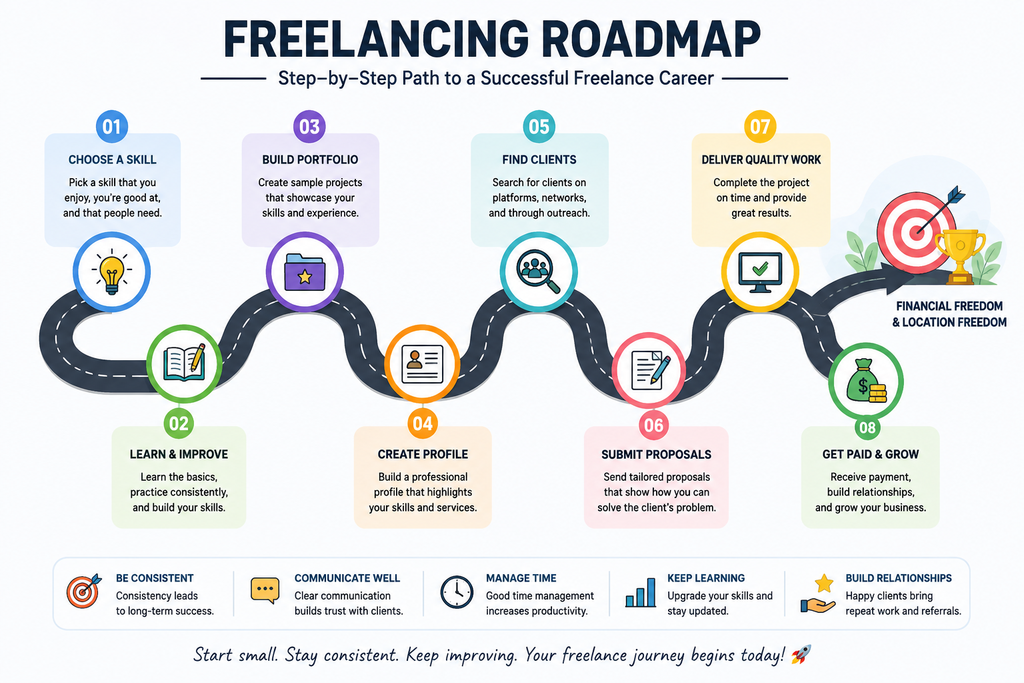
How to Start Freelancing Step by Step
If you are wondering how to start freelancing without previous freelance experience, focus on building a strong foundation instead of trying to do everything at once.
1. Choose One Marketable Skill
Your first decision should be what service you want to sell.
Avoid choosing a skill simply because someone online claims that it is easy to make money from. Instead, consider three things:
- What are you interested in learning?
- What can you become reasonably good at?
- Do people or businesses actually need this service?
For example, instead of saying, “I want to work online,” choose something more specific such as:
“I want to provide short-form video editing for small businesses.”
That gives you a clearer target audience, portfolio direction, and service offering.
2. Learn the Fundamentals
You do not need to know everything before starting, but you should understand the fundamentals of your chosen skill.
If you want to become a freelance graphic designer, learn design principles, typography, layout, image editing, and the software commonly used in your field.
If you want to provide SEO services, learn keyword research, search intent, on-page optimization, technical SEO basics, internal linking, and content structure.
The goal is not to become an expert overnight. The goal is to become capable of delivering a useful service reliably.
3. Practice Before Looking for Clients
One of the most important parts of how to start freelancing is practice.
If you have no client history, create your own projects.
For example:
- A writer can create three sample articles.
- A designer can create sample logos or social media designs.
- A video editor can edit sample promotional videos.
- A web developer can build a small demonstration website.
- A social media manager can create a sample content calendar.
These projects give you something concrete to show potential clients.
4. Build a Portfolio
A portfolio is a collection of work that demonstrates what you can do.
You do not need dozens of projects. A small collection of strong examples can be more useful than a large collection of weak work.
For each portfolio project, explain:
- What the project was
- What problem you were solving
- What you created
- Which tools or skills you used
- What the final result looked like
If the project was created for practice rather than a real client, say so. Never present fictional work as paid client work.
5. Create a Professional Profile
Your freelance profile should quickly answer three questions:
What do you do?
Who do you help?
Why should a client consider you?
For example:
“I help small businesses create engaging short-form videos for social media.”
This is stronger than a vague description such as:
“I am a freelancer who can do many things.”
Platforms such as Upwork emphasize the importance of completing your freelancer profile, including skills, portfolio, and work history.
6. Choose Where to Find Clients
Another important part of how to start freelancing is deciding where you will look for work.
Popular approaches include:
- Freelance marketplaces
- Professional communities
- Personal networking
- Direct outreach
- Referrals
- Your own website or portfolio
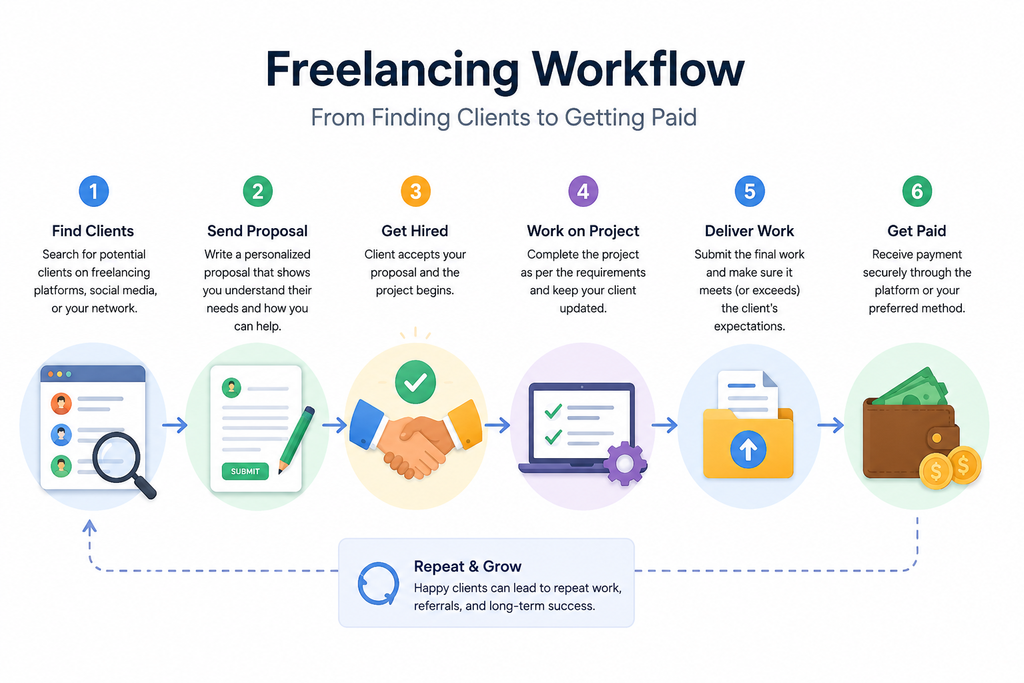
On Upwork, freelancers create profiles, search for opportunities, submit proposals, complete projects, and receive payments through the platform.
On Fiverr, freelancers create services called Gigs. A Gig describes the service, pricing, requirements, and other details clients need before ordering.
Do not feel that you need to join every platform. Starting with one or two channels can make it easier to stay organized.
7. Write Better Proposals
A proposal should not simply say:
“Hello, I can do this job. Please hire me.”
Instead, show that you understand the client’s problem.
A useful proposal can include:
- A short acknowledgement of the client’s need
- Your relevant skill or experience
- How you would approach the project
- A realistic timeframe
- A clear next step
For example:
“I noticed you need short promotional videos for your social media campaigns. I can edit your existing footage into concise videos with captions, transitions, and platform-appropriate formatting. I can first create one sample direction so we can confirm the style before completing the remaining videos.”
The objective is to make the client feel that you understood the project rather than sending a generic message.
How to Price Your Freelance Services
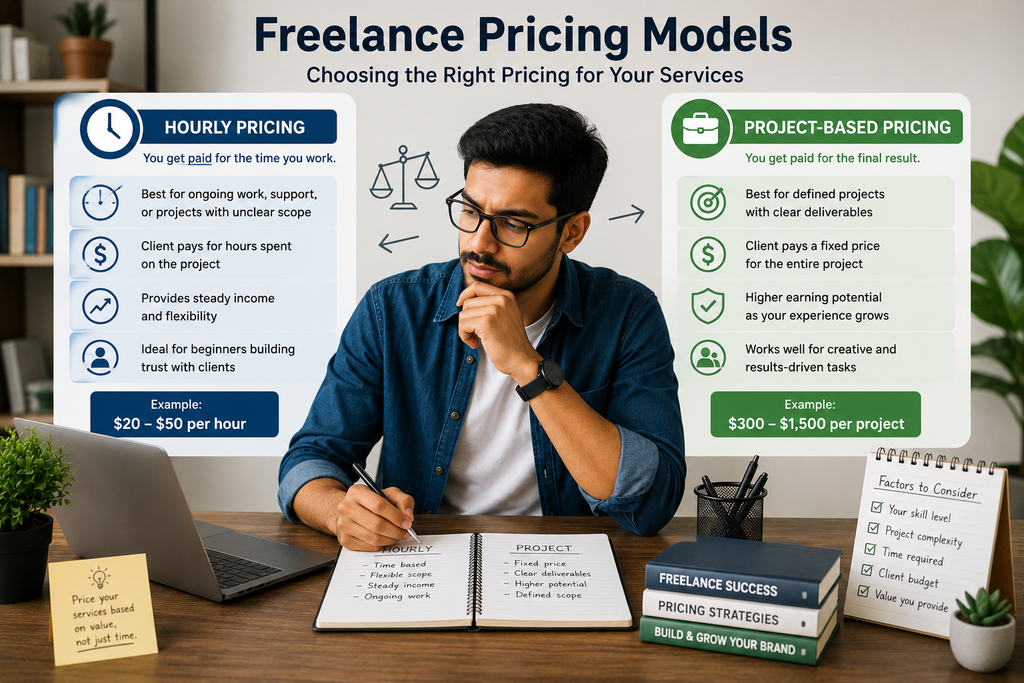
Pricing is one of the most difficult questions for people learning how to start freelancing.
There are two common approaches:
Hourly Pricing
You charge for the amount of time you spend working.
This can be useful when the project scope may change or when the client specifically wants hourly support.
Project-Based Pricing
You charge one agreed price for completing a defined project.
For example:
| Service | Example Pricing Structure |
|---|---|
| Blog writing | Price per article |
| Logo design | Price per project |
| Video editing | Price per video |
| Website development | Price per project |
| Social media management | Monthly package |
Your price should consider your skill level, project complexity, required time, revisions, communication, and the value of the service.
Do not automatically compete by offering the lowest possible price. Extremely low pricing can make it difficult to sustain your work and may attract clients who focus only on price.
Payment practices also vary by project. Freelancers may use hourly or project-based pricing depending on the service and client arrangement.
How to Get Your First Freelance Client
Getting the first client is often the hardest stage because you do not yet have a long record of freelance reviews.
A practical approach is to focus on a specific service and audience.
For example:
Too broad:
“I provide digital marketing services.”
More specific:
“I help local restaurants create social media content and short promotional videos.”
The second statement makes it easier for a potential client to understand what you offer.
You can also:
- Apply for projects that closely match your skills
- Contact businesses with a genuine and specific reason
- Ask existing professional contacts for referrals
- Publish useful examples of your work
- Improve your portfolio continuously
- Follow up professionally when appropriate
Your first project does not need to be your biggest project. Its value may be the experience, portfolio piece, testimonial, and relationship you build.
How to Start Freelancing Without Experience
One of the most common beginner questions is whether you can freelance without previous professional experience.
The answer is yes, but you still need evidence that you can perform the service.
If you have no client work, create portfolio projects.
For example, an aspiring content writer could create:
- A technology article
- A business article
- A product tutorial
A beginner video editor could create:
- A social media advertisement
- A YouTube short
- A before-and-after editing sample
This approach does not replace real experience, but it gives potential clients something to evaluate.
The key is to be honest about what is practice work and what is actual client work.
How Freelancers Get Paid
Payment methods depend on the platform, client, country, and available financial services.
Before accepting a project, make sure you understand:
- The total price
- Payment schedule
- Deliverables
- Revision limits
- Deadline
- Currency
- Payment method
- Any platform fees
When working through a freelance marketplace, understand its payment and dispute rules before starting a project.
For example, Upwork explains that its payment processes differ between hourly and fixed-price contracts and provides specific protections subject to its requirements.
If you work directly with clients, use clear written agreements and invoices where appropriate.
Common Freelancing Mistakes to Avoid
Knowing how to start freelancing also means understanding what can go wrong.
Trying to Offer Too Many Services
A profile that says you provide writing, design, coding, marketing, translation, video editing, and ten other services can appear unfocused.
Start with one core service and expand later.
Having No Portfolio
Clients need evidence of your ability. Build samples before applying aggressively for work.
Sending Generic Proposals
Copying the same proposal for every project usually makes it difficult to demonstrate that you understand the client’s specific needs.
Accepting Unclear Projects
Before starting, make sure you understand the deliverables, deadline, revisions, and payment terms.
Working for Extremely Low Prices
Lowering your price can help you become competitive, but consistently underpricing your work can make freelancing difficult to sustain.
Ignoring Communication
A skilled freelancer can still lose clients if they communicate poorly. Respond professionally, provide updates, and tell the client early if a problem affects the deadline.
Chasing Every Client
Not every project is a good fit. Learning to evaluate clients and projects is part of building a sustainable freelance career.
Best Practices for Freelancers
Once you understand how to start freelancing, your next goal should be consistency.
Use these practices:
- Keep your portfolio updated
- Specialize instead of trying to serve everyone
- Set realistic deadlines
- Confirm project requirements before starting
- Keep communication professional
- Track your income and expenses
- Save examples of completed work
- Ask satisfied clients for appropriate feedback or testimonials
- Continue improving your skills
- Build relationships instead of focusing only on one-time projects
On platforms such as Upwork, successful projects can contribute to stronger reputation and future opportunities.
Real-World Example: Starting as a Beginner
Imagine someone wants to become a freelance video editor but has never worked with a paying client.
Instead of immediately applying for every video editing job, they could follow this process:
Week 1: Learn basic video editing and choose a specific type of service.
Week 2: Create three sample videos for different hypothetical businesses.
Week 3: Build a simple portfolio and professional freelance profile.
Week 4: Begin applying for relevant projects and improving proposals based on responses.
The exact timeline will vary from person to person. The important principle is to build the skill, create evidence, present the service clearly, and then consistently look for suitable clients.
A Simple Freelancing Checklist
If you are still unsure how to start freelancing, use this basic roadmap:
- Choose one marketable skill
- Learn the fundamentals
- Practice regularly
- Create 3–5 strong portfolio samples
- Define your target client
- Create a professional profile
- Decide how you will price your service
- Choose one or two client acquisition channels
- Start submitting tailored proposals
- Communicate professionally
- Deliver work on time
- Collect legitimate reviews or testimonials
- Improve your skills and portfolio continuously
Frequently Asked Questions
Can I start freelancing with no experience?
Yes. You can begin by developing a skill and creating portfolio samples that demonstrate your ability. Be transparent about which projects are personal or practice work.
How much money can a beginner freelancer make?
There is no universal beginner income. Earnings depend on the skill, experience, demand, pricing, number of clients, location, platform fees, and amount of work available.
What is the easiest freelance skill to learn?
There is no single easiest skill for everyone. Choose a skill that matches your interests and abilities while having a real market for the service.
Do I need a degree to become a freelancer?
Not necessarily. Requirements vary by profession and client. Many freelance services are evaluated primarily through skills, portfolio quality, communication, and relevant experience.
Can I freelance from home?
Yes. Many freelance services can be delivered remotely, provided you have the necessary equipment, internet connection, software, and a suitable way to communicate with clients.
Which freelance platform should beginners use?
There is no universal best platform. Consider the type of service you offer, the platform’s rules, fees, availability in your country, competition, and the type of clients you want to reach.
For example, Upwork currently supports freelancers in 180+ countries, although restrictions apply depending on location and other eligibility requirements. Fiverr also has its own freelancer onboarding and approval requirements.
How long does it take to get the first freelance client?
There is no guaranteed timeframe. Some beginners may find work quickly, while others need weeks or months to develop their skills, portfolio, proposals, and client-acquisition strategy.
Is freelancing a real career?
Yes. Freelancing can become a sustainable career when you develop valuable skills, consistently deliver quality work, manage clients professionally, and build reliable systems for finding and completing projects.
If these articles do not yet exist on HanadReview.com, they can be future content opportunities.
Final Thoughts
Learning how to start freelancing does not require you to have everything figured out from day one. A better approach is to start with one useful skill, practice it consistently, create credible examples of your work, and learn how to communicate your value to potential clients.
Your first objective should not be to build a huge freelance business immediately. Focus on becoming good at one service and completing your first projects professionally.
As your experience grows, you can improve your portfolio, increase your rates when appropriate, specialize in higher-value services, and develop stronger relationships with clients.
Freelancing rewards more than technical ability. Reliability, communication, organization, problem-solving, and professionalism can be just as important.
If you are serious about how to start freelancing, begin with one skill, one clear service, and one practical portfolio project. Then take consistent steps toward finding your first client.