
What Is Digital Marketing? An Amazing Beginner’s Guide for 2026
Introduction
If you have ever searched for a business on Google, watched a product video on social media, received a promotional email, or clicked an online advertisement, you have already interacted with digital marketing.
But what exactly is digital marketing, and how does it work?
Digital marketing is the use of digital channels, platforms, and technologies to promote a business, product, service, organization, or idea and connect with a target audience. It can include search engines, websites, social media, email, online advertising, video, and other digital channels.
Unlike traditional marketing, digital marketing gives businesses more ways to reach specific audiences, measure results, and adjust campaigns based on performance. Modern digital marketing can also involve automation, analytics, and artificial intelligence.
This guide explains what digital marketing means, how it works, the major types, its benefits and limitations, common mistakes, practical examples, and how beginners can build a simple digital marketing strategy.
What Is Digital Marketing?
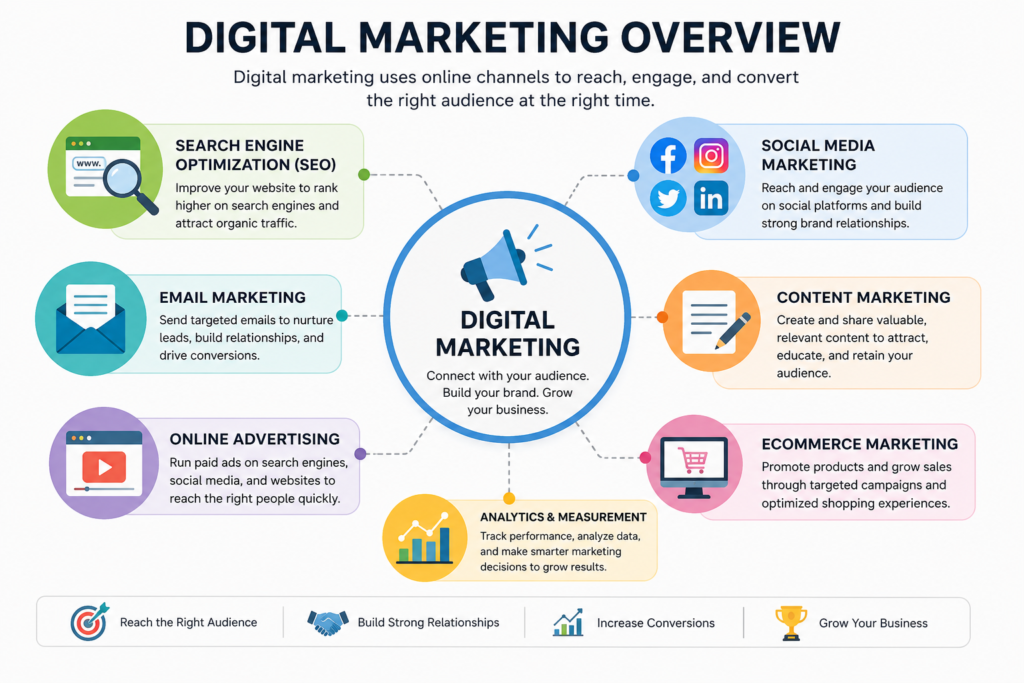
Digital marketing is marketing carried out through digital technologies and channels.
In simple terms, it means using the internet and digital devices to reach people, communicate with them, build awareness, generate interest, and encourage useful actions.
Common digital marketing channels include:
- Search engines
- Websites and blogs
- Social media
- Online advertising
- Video platforms
- Content marketing
- Mobile apps
- Online communities
For example, imagine a small clothing business that creates a website, publishes helpful fashion content, appears in Google Search, posts videos on social media, and sends emails to people who have signed up for updates.
All of these activities can be part of its digital marketing strategy.
Digital marketing is broader than simply running advertisements. It can involve attracting people through useful content, helping them discover a business through search, communicating through email, and measuring what happens after someone interacts with a campaign.
Why Is Digital Marketing Important?
Digital marketing matters because people increasingly use digital channels to discover information, research options, communicate with businesses, and make decisions.
A business can use digital marketing to:
- Build brand awareness
- Reach a specific audience
- Increase website traffic
- Generate leads
- Communicate with customers
- Promote useful content
- Measure campaign performance
- Improve customer relationships
One important advantage is measurability. Digital campaigns can produce data that helps marketers understand what is working and what needs improvement.
For example, a business may discover that visitors coming from search engines spend more time reading its content than visitors from a particular advertising campaign. That information can influence future marketing decisions.
Digital marketing can therefore be treated as an ongoing process rather than a single campaign.
How Does Digital Marketing Work?
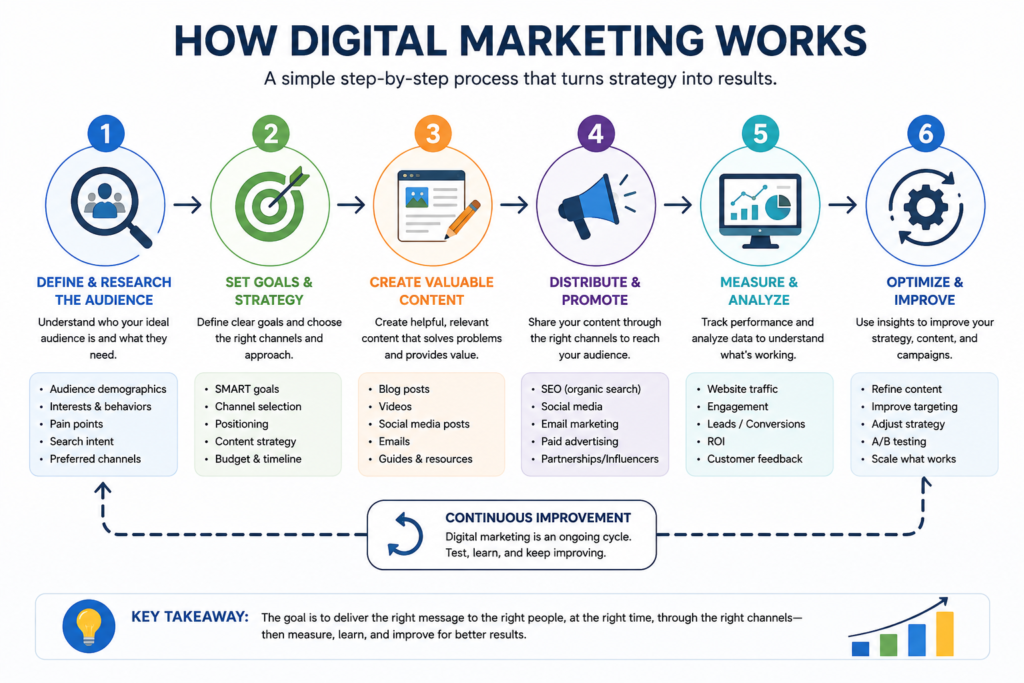
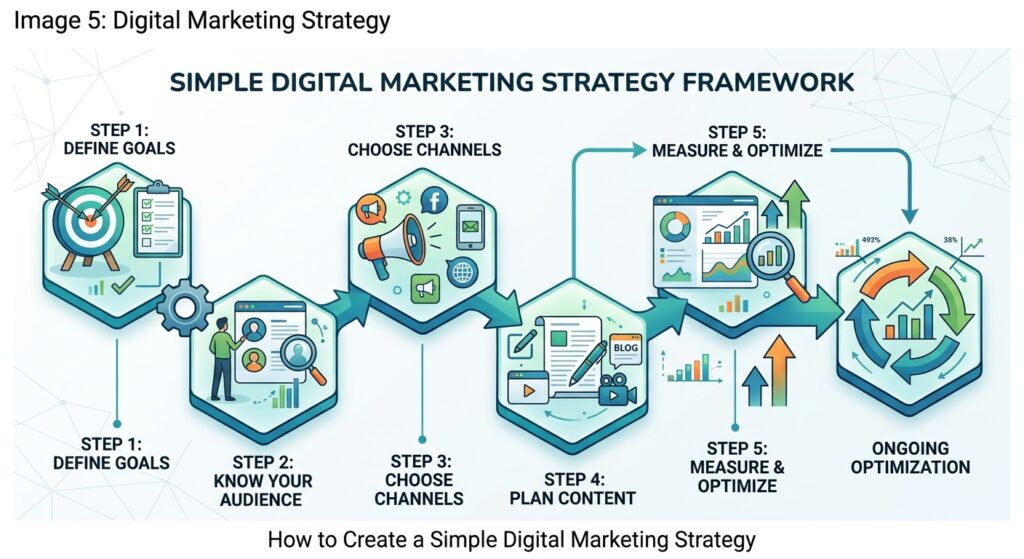
Although digital marketing can become complex, the basic process is easier to understand when divided into several stages.
1. Define the Goal
First, determine what the marketing effort is supposed to accomplish.
Possible goals include:
- Increasing website traffic
- Building brand awareness
- Generating leads
- Increasing sales
- Growing an email audience
- Improving customer retention
A campaign without a clear goal can be difficult to evaluate.
2. Understand the Audience
The next step is identifying who the business wants to reach.
This may include information such as:
- Age range
- Location
- Interests
- Problems
- Search behavior
- Buying needs
- Preferred digital platforms
The purpose is not simply to collect information. It is to understand what the audience needs and how the business can provide useful value.
3. Choose the Right Channels
Not every business needs to use every digital marketing channel.
A company that wants to attract people searching for solutions may focus heavily on SEO and content.
Another business may benefit more from social media or video.
The right channel depends on the audience, goals, resources, and type of business.
4. Create Useful Content or Messages
Once the audience and channels are clear, the business can create content.
Examples include:
- Blog articles
- Videos
- Social media posts
- Guides
- Email newsletters
- Infographics
- Landing pages
Good digital marketing is not simply about publishing more content. The content should answer questions, solve problems, explain something clearly, or provide another meaningful reason for people to pay attention.
5. Reach the Audience
Content and marketing messages can reach people through organic methods, paid advertising, or exposure generated by others.
Mailchimp groups digital media into paid, owned, and earned media:
- Paid media: Advertising that a business pays for.
- Owned media: Digital channels the business controls, such as its website or email list.
- Earned media: Exposure gained through recommendations, mentions, sharing, reviews, or other forms of public attention.
6. Measure the Results
Finally, marketers examine performance.
Depending on the goal, they may look at:
- Website visits
- Search impressions
- Clicks
- Engagement
- Leads
- Conversion rates
- Email performance
- Advertising results
The results can then be used to improve future campaigns.
Main Types of Digital Marketing
Digital marketing includes several different disciplines. Each one has a different role.
1. Search Engine Optimization (SEO)
SEO, or Search Engine Optimization, involves improving a website and its content so that search engines can better understand it and users can discover it through search.
Google explains that SEO helps search engines understand content and helps users find websites through search.
For example, a website about computer technology might publish an article answering:
What is cloud computing?
If the article is useful, well-structured, and technically accessible, it may have an opportunity to appear in relevant search results.
SEO can involve:
- Helpful content
- Search intent
- Descriptive titles
- Relevant headings
- Internal links
- Technical website improvements
- Clear page structure
SEO does not guarantee a particular Google ranking. Search visibility can take time and depends on many factors.
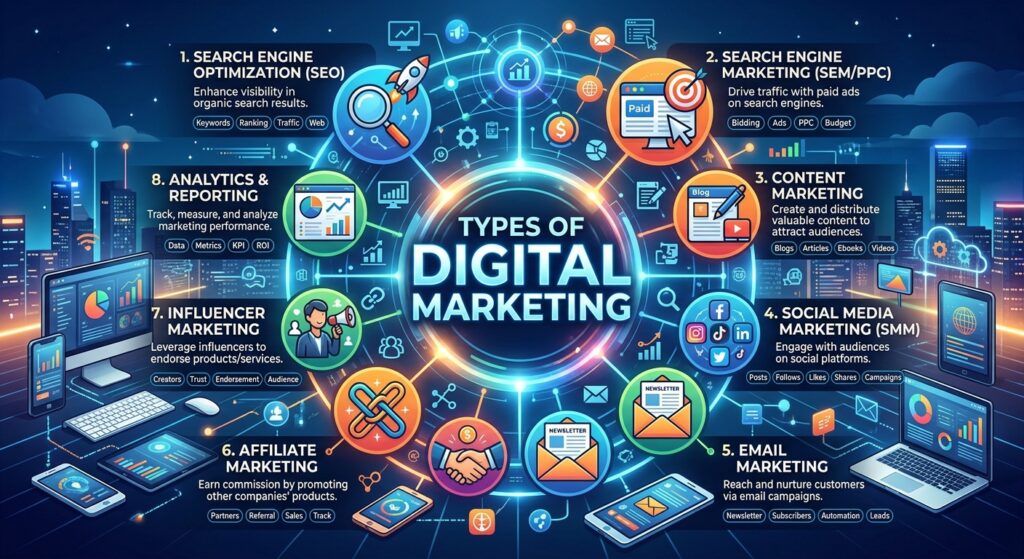
2. Content Marketing
Content marketing focuses on creating and distributing useful information for a specific audience.
Examples include:
- Blog posts
- Tutorials
- Guides
- Videos
- Podcasts
- Research articles
- Educational graphics
For example, a software company could publish tutorials that explain how to organize digital files more effectively.
The content helps people solve a problem while also introducing them to the organization behind it.
Content marketing and SEO often work together, but they are not exactly the same. SEO focuses heavily on search visibility, while content marketing is broader and focuses on creating useful information and building relationships with an audience.
3. Social Media Marketing
Social media marketing uses social platforms to communicate with audiences and distribute content.
Businesses may use social media to:
- Share educational content
- Answer questions
- Announce updates
- Build brand awareness
- Communicate with customers
- Share videos and images
Social media can include both organic content and paid advertising.
The most effective platform depends on where the intended audience actually spends time. Creating an account on every platform is not automatically a good strategy.
4. Email Marketing
Email marketing involves communicating with people through email.
Businesses may use email to send:
- Newsletters
- Educational content
- Product updates
- Important announcements
- Personalized messages
A useful email strategy focuses on relevance rather than sending large numbers of messages.
For example, a website about technology could send subscribers a weekly email containing new tutorials and technology explanations.
5. Pay-Per-Click (PPC) Advertising
PPC advertising is a form of paid digital advertising where advertisers generally pay according to specific interactions or campaign objectives.
Search advertising is one common example.
Google Ads supports multiple campaign and advertising channels, including Search, Display, Shopping, Video, and Performance Max campaigns.
Paid advertising can help businesses reach audiences more quickly than waiting for organic visibility, but it requires careful planning and monitoring.
6. Video Marketing
Video marketing uses video content to communicate information or promote a brand.
Examples include:
- Tutorials
- Product demonstrations
- Educational videos
- Short-form videos
- Interviews
- Explainer videos
Video can be particularly useful when a topic is easier to demonstrate visually than explain through text alone.
For example, a computer repair business could publish a video explaining how to identify common laptop problems.
7. Influencer Marketing
Influencer marketing involves working with people who have an established audience and influence within a particular community.
The relationship may involve sponsored content, product demonstrations, educational content, or other collaborations.
However, businesses should evaluate whether an influencer’s audience actually matches their target customers. A large following does not automatically mean a campaign will be effective.
8. Affiliate Marketing
Affiliate marketing is a performance-based model in which partners promote products or services and may receive a commission when qualifying actions occur.
For example, a website could publish an educational comparison and include a clearly disclosed affiliate relationship where appropriate.
Affiliate marketing is one part of the wider digital marketing ecosystem, but digital marketing itself is much broader than affiliate marketing.
Digital Marketing vs. Traditional Marketing
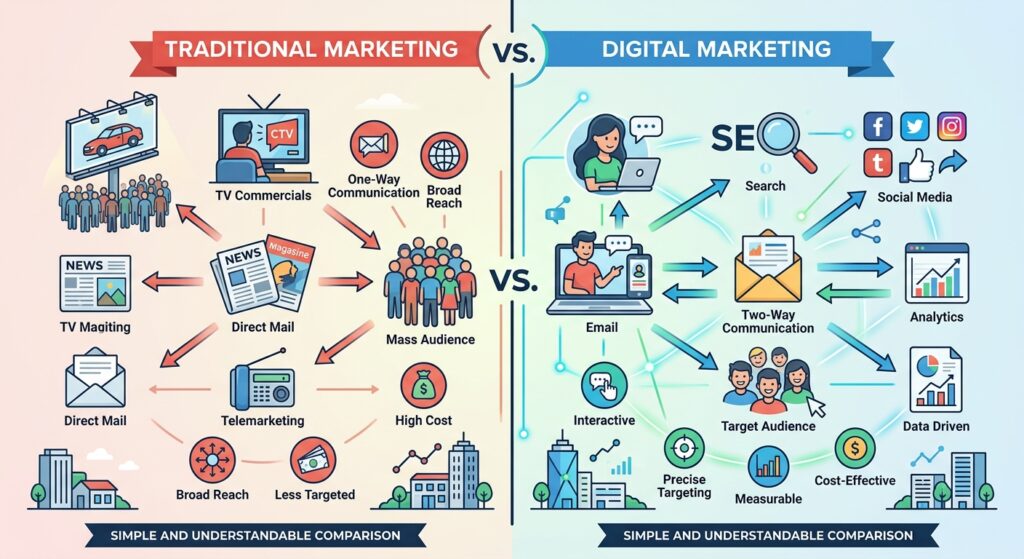
Digital marketing and traditional marketing both aim to communicate with audiences, but they use different channels and methods.
| Digital Marketing | Traditional Marketing |
|---|---|
| Websites | Newspapers |
| Search engines | Billboards |
| Social media | Radio |
| Television | |
| Online advertising | Magazines |
| Video platforms | Direct mail |
| Digital analytics | Traditional audience research |
Digital marketing often provides more immediate performance data and more options for targeting and optimization.
Traditional marketing can still be useful, especially when businesses want broad local or offline exposure.
The two approaches do not necessarily have to compete. A business can use both when they support its goals.
Benefits of Digital Marketing
Wider Reach
A website or online campaign can potentially reach people beyond the business’s immediate geographic area.
This can be particularly useful for businesses that serve customers nationally or internationally.
Measurable Performance
Digital marketing provides many measurable signals.
Businesses can analyze traffic, clicks, engagement, leads, and other performance indicators depending on the channel.
Audience Targeting
Many digital platforms provide ways to reach particular audience groups based on factors such as interests, behavior, location, or search activity.
Flexible Budgets
Digital marketing can be used at different budget levels.
A small business can begin with organic content and gradually introduce paid campaigns when it has a clear reason to do so.
Faster Feedback
Digital channels can provide feedback relatively quickly.
A marketer can identify which content attracts attention and use those observations to improve future work.
Personalization
Digital technologies can allow businesses to tailor messages and experiences to different audiences.
However, personalization should remain useful and respect applicable privacy requirements.
Challenges and Disadvantages of Digital Marketing
Digital marketing has advantages, but it is not effortless.
Competition
Many businesses compete for the same search results, social media attention, and advertising audiences.
Constant Changes
Search algorithms, social platforms, advertising systems, and audience behavior can change.
Requires Consistency
Publishing one article or one social media post rarely creates a complete marketing strategy.
Data Can Be Misleading
High traffic does not necessarily mean a campaign is successful.
For example, 10,000 visitors who take no useful action may be less valuable than 500 highly relevant visitors.
Privacy Responsibilities
Businesses that collect or process customer information must consider applicable privacy requirements and handle data responsibly.
Paid Advertising Can Become Expensive
Advertising costs can increase when campaigns are poorly targeted or optimized.
Digital marketing therefore requires testing, measurement, and continuous improvement.
How to Create a Simple Digital Marketing Strategy
Beginners do not need a complicated strategy to get started.
Step 1: Define One Main Objective
Choose a clear objective.
For example:
Increase qualified traffic to the company’s website.
A specific objective makes it easier to measure progress.
Step 2: Identify the Target Audience
Ask:
- Who needs this product or service?
- What problem are they trying to solve?
- What information are they searching for?
- Which digital channels do they use?
Step 3: Select Two or Three Appropriate Channels
Do not automatically try everything.
For example:
Local service business
- Google Search
- Local content
- Social media
Educational website
- SEO
- Content marketing
Visual brand
- Social media
- Video
- Influencer partnerships
The best combination depends on the business and audience.
Step 4: Create a Content Plan
Decide what useful information you will publish.
A simple plan might include:
- Two educational articles per month
- Three social posts per week
- One email newsletter per week
The exact schedule matters less than producing useful, consistent content.
Step 5: Measure Performance
Choose metrics connected to the objective.
For example:
| Goal | Useful Metrics |
|---|---|
| Brand awareness | Reach, impressions |
| Website traffic | Sessions, search clicks |
| Lead generation | Leads, conversion rate |
| Email growth | Subscribers, engagement |
| Advertising | Clicks, conversions, cost |
Step 6: Improve Based on Evidence
If something performs poorly, investigate why.
Possible questions include:
- Is the audience wrong?
- Is the content answering the wrong question?
- Is the landing page unclear?
- Is the campaign targeting too broadly?
- Is the message difficult to understand?
Use evidence rather than assumptions to guide changes.
Common Digital Marketing Mistakes to Avoid
Trying Every Platform
Being present everywhere is not the same as having an effective strategy.
Start with channels that match your audience and goals.
Focusing Only on Promotion
People do not want every interaction to feel like an advertisement.
Educational and useful content can help build trust.
Ignoring Search Intent
An article can target a popular keyword but still fail if it does not answer what the searcher actually wants.
Chasing Vanity Metrics
Likes and followers can be useful signals, but they should not automatically be treated as business success.
Publishing Without Measuring
Without performance data, it becomes difficult to understand what should be improved.
Expecting Instant Results
Some digital marketing activities, especially SEO and content marketing, can take time to produce meaningful results. Google notes that changes to search visibility can sometimes take from hours to several months to be reflected.
Using Misleading Content
Clickbait may generate attention temporarily, but misleading users can damage trust.
Real-World Digital Marketing Example
Imagine a small Somali restaurant that wants more customers.
It could build a simple website containing:
- Menu information
- Opening hours
- Location
- Contact information
- Helpful food-related content
It could then use social media to publish photos and short videos, create useful local content for search engines, and use email or messaging channels for customers who have voluntarily subscribed to updates.
The restaurant could measure:
- Website visits
- Search visibility
- Calls or inquiries
- Direction requests
- Social engagement
- Customer actions
The important point is that these activities should work toward a clear business objective rather than being performed simply because other businesses are doing them.
Digital Marketing and Artificial Intelligence
Artificial intelligence is increasingly being used in digital marketing.
AI can assist marketers with tasks such as:
- Content brainstorming
- Audience analysis
- Data analysis
- Personalization
- Automation
- Campaign optimization
- Customer communication
However, AI does not remove the need for human judgment.
Marketers still need to evaluate whether information is accurate, useful, appropriate for the audience, and aligned with the organization’s goals.
A strong approach is to use AI as a supporting technology rather than assuming it can replace strategy, expertise, and editorial judgment.
Frequently Asked Questions
What is digital marketing in simple words?
Digital marketing is the process of using digital channels such as websites, search engines, social media, email, and online advertising to reach and communicate with an audience.
What are the main types of digital marketing?
Major types include SEO, content marketing, social media marketing, email marketing, PPC advertising, video marketing, influencer marketing, and affiliate marketing.
Is digital marketing the same as online advertising?
No. Online advertising is one part of digital marketing. Digital marketing also includes organic search, content, email, social media, websites, and other digital activities.
Is SEO part of digital marketing?
Yes. SEO is one of the major areas of digital marketing. It focuses on helping search engines understand content and helping users discover websites through search.
Is digital marketing useful for small businesses?
Yes. Small businesses can use digital marketing to build visibility, communicate with customers, publish useful information, and measure marketing performance. The appropriate channels depend on the business, audience, goals, and budget.
How long does digital marketing take to work?
There is no universal timeline. Paid campaigns can generate traffic relatively quickly, while SEO and content marketing may require more time to build visibility. Results depend on the channel, competition, quality, audience, and strategy.
Do I need a large budget to start digital marketing?
Not necessarily. A business can begin with organic activities such as creating useful content, improving its website, and maintaining a social media presence. Paid advertising can be added when it supports a clear objective.
Can AI replace digital marketers?
AI can automate and support many marketing tasks, but effective digital marketing still requires strategy, judgment, creativity, audience understanding, and responsible decision-making.
Final Thoughts
Digital marketing is much more than posting advertisements online.
It is a broad approach to reaching people through digital channels, understanding their needs, providing useful information, building relationships, and measuring results.
The most effective strategy usually begins with a simple question:
What does the audience need, and how can the business provide useful value through the digital channels where that audience is present?
From there, businesses can choose appropriate channels, create helpful content, measure performance, and improve their approach over time.
For beginners, the best starting point is not trying every marketing platform at once. Start with a clear goal, understand the audience, choose a few relevant channels, create genuinely useful content, and use real performance data to guide future decisions.
That approach makes digital marketing easier to understand—and much easier to manage.
If an existing article does not yet cover one of these topics, it can be added as a future HanadReview educational article.
How to Start Freelancing: A Complete Beginner’s Guide in 2026
[…] to Start Freelancing Step by […]
How Cloud Storage Works in 2026: A Complete Beginner’s Guide – Hanad review
[…] Best Practices for Using Cloud Storage […]