
What Is SEO? The Ultimate & Complete Beginner’s Guide to Search Engine Optimization in 2026
Introduction
When people search for information, products, services, or answers online, search engines help them find relevant websites. For a website owner, the cha
llenge is making sure search engines can understand the website and that people can discover its pages through search.
That is where SEO comes in.
SEO stands for Search Engine Optimization. It is the practice of improving a website and its content so search engines can better understand it and users can more easily find it through organic search results. Google describes SEO as helping search engines understand your content and helping users find your site and decide whether to visit it.
But SEO is much more than adding keywords to an article. Effective SEO combines useful content, clear website structure, technical accessibility, descriptive titles, relevant links, good user experience, and an understanding of what people are actually searching for.
This guide explains what SEO is, how it works, why it matters, the main types of SEO, common mistakes, and practical steps beginners can take to improve a website in 2026.
What Is SEO?
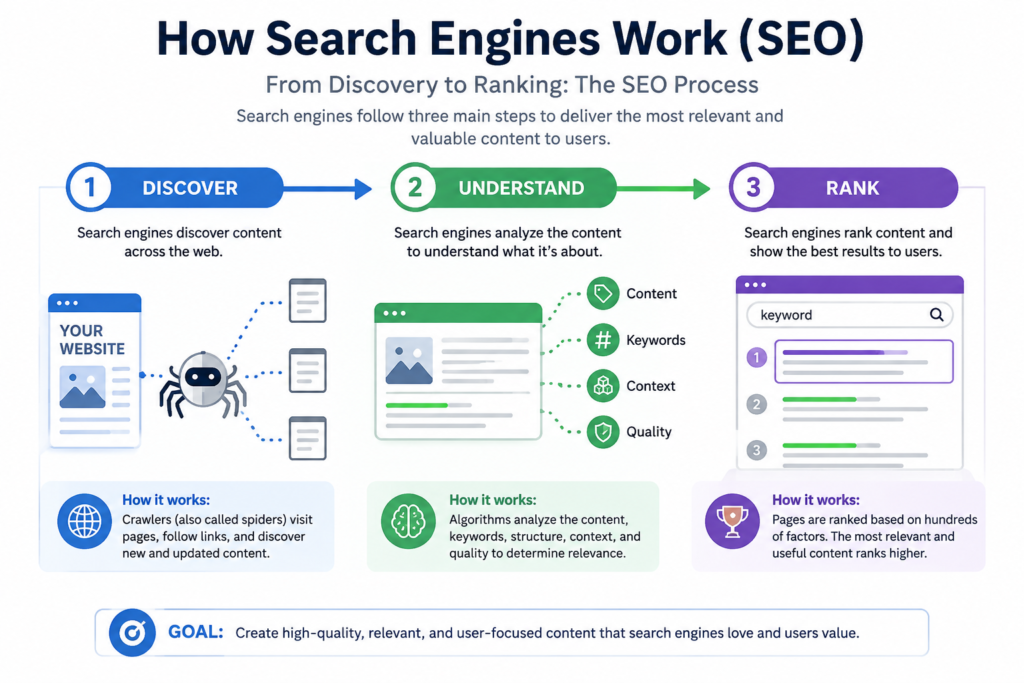
SEO, or Search Engine Optimization, is the process of improving a website so search engines can discover, understand, and potentially show its pages to people searching for relevant information.
Google’s current SEO Starter Guide explains that SEO is about helping search engines understand website content and helping users find a site through search.
Imagine you publish an article called “What Is Cloud Computing?”
Without SEO, search engines may still discover the page, but important information about the page may be unclear. A well-optimized page, on the other hand, can make its subject easier to understand through a descriptive title, useful headings, readable content, logical URLs, relevant internal links, and appropriate metadata.
SEO does not guarantee that a page will reach the first position in Google. Google explicitly states that there are no secrets that automatically rank a site first.
The real goal is to make a website easy for both people and search engines to understand.
Why Is SEO Important?
SEO matters because search engines can be an important way for people to discover websites.
Google says that improving search visibility can help more relevant users find a site’s content, while Search Console provides website owners with information about how their pages perform in Google Search.
For a website owner, effective SEO can help with:
- Increasing visibility in organic search.
- Bringing relevant visitors to useful pages.
- Helping search engines understand the site’s topics.
- Making website content easier to navigate.
- Building long-term visibility around valuable topics.
- Helping users decide whether a search result is relevant to them.
However, traffic alone should not be the main objective.
A page that attracts thousands of visitors but does not answer their questions is not necessarily successful. Google recommends creating helpful, reliable, people-first content rather than content primarily designed to manipulate search rankings.
How Does SEO Work?
To understand SEO, it helps to understand the basic process Google uses to handle web pages.
Google Search generally works through three major stages:
- Crawling
- Indexing
- Serving search results
Google explains that not every page necessarily makes it through every stage.
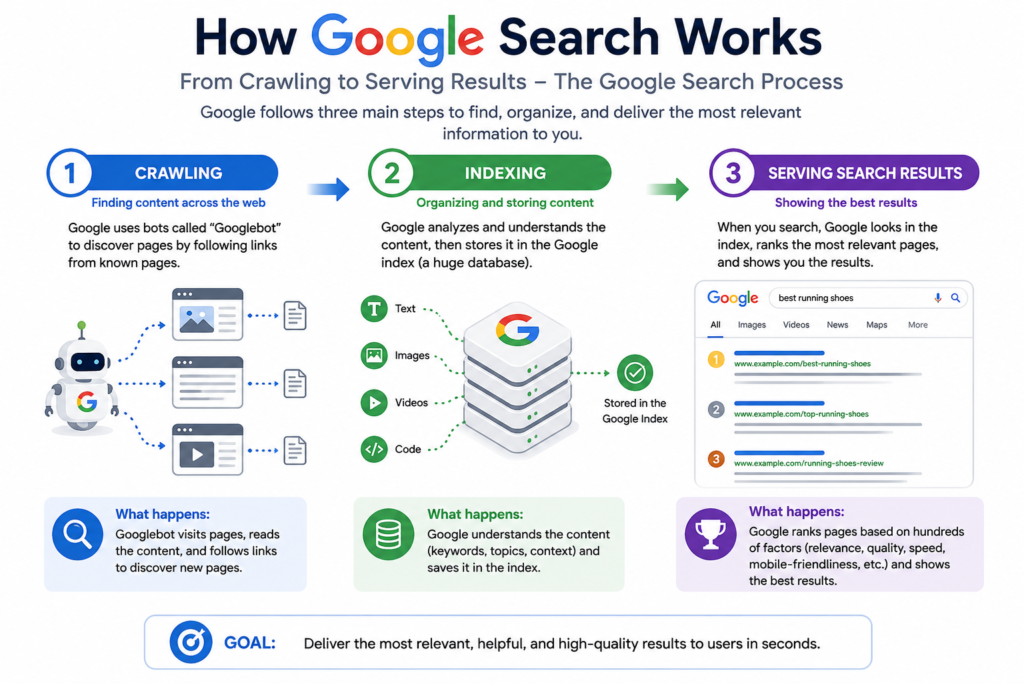
1. Crawling
Crawling is the process of discovering and accessing web pages.
Google uses automated crawlers, including Googlebot, to find pages across the web. Pages can be discovered through links from other pages, previously known URLs, and submitted sitemaps.
For example, suppose your website publishes a new article about artificial intelligence. Google may discover the article through a link from your homepage, category page, another article, or a sitemap.
If Google cannot access the page because of technical problems, login restrictions, or certain crawling rules, it may not be able to process the page normally.
2. Indexing
After crawling a page, Google analyzes its content.
The indexing process can include examining the text, images, videos, title elements, and other information associated with the page. Google also determines whether a page is a duplicate and which version should be treated as canonical.
Think of the Google index as a huge database containing information about pages that Google has processed.
Being crawled does not automatically mean a page will be indexed. Google notes that indexing is not guaranteed.
3. Serving Search Results
When someone enters a search query, Google searches its index and returns pages it considers relevant and useful for that query.
Google says ranking uses many signals, and results can vary depending on factors such as the query, language, location, and device.
This is why SEO should focus on more than one keyword. A strong page should satisfy the underlying search intent behind a query.
The Main Types of SEO
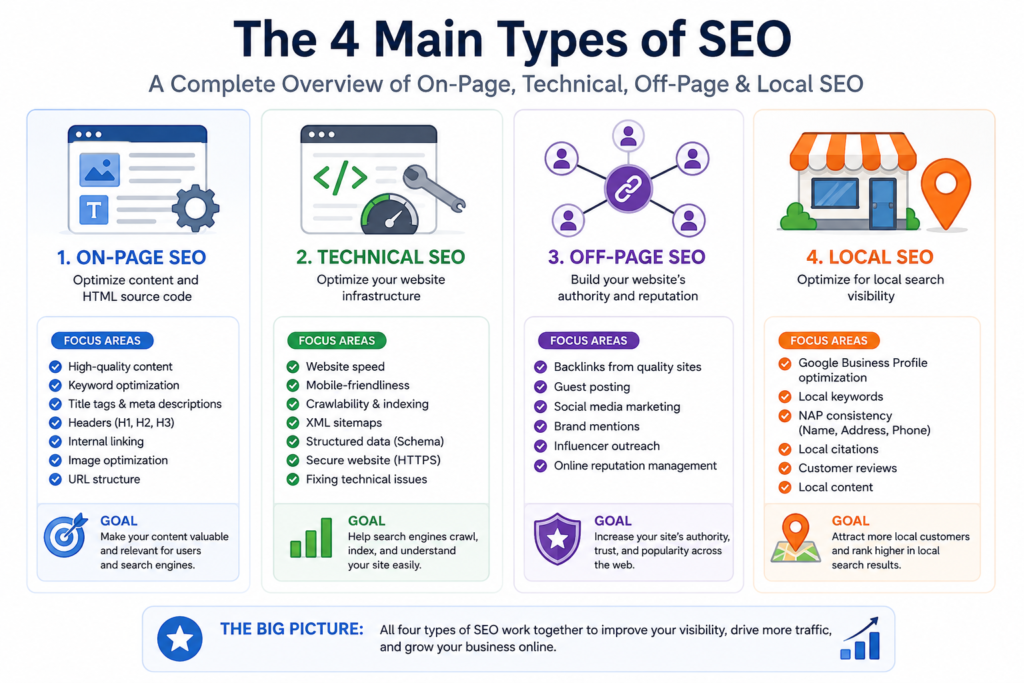
SEO can be divided into several areas. These areas overlap, but each has a different purpose.
On-Page SEO
On-page SEO focuses on elements that exist directly on a webpage.
Examples include:
- Page titles
- Headings
- Main content
- Internal links
- Image alt text
- URLs
- Descriptive metadata
- Content organization
The purpose is to make the page clear, useful, and understandable.
For example, an article about SEO should have a descriptive title and headings that accurately explain topics such as keyword research, technical SEO, content, and search intent.
Technical SEO
Technical SEO focuses on whether search engines can effectively access, crawl, process, and understand a website.
It can involve:
- Crawl accessibility
- Indexing controls
- XML sitemaps
- Canonical URLs
- HTTPS
- Mobile usability
- Page performance
- Structured data
- Website architecture
Google’s developer guidance emphasizes that websites should be secure, fast, accessible, and functional across devices.
Technical SEO does not mean changing everything simply because a technical setting exists. The objective is to remove unnecessary obstacles that could interfere with users or search engines.
Off-Page SEO
Off-page SEO refers to signals and activities that happen outside your own website.
One important example is links from other websites.
However, SEO should not become a search for thousands of artificial links. Google warns against link schemes and says that submitting a site to thousands of search engines or using link popularity schemes is generally not useful.
A stronger approach is to create useful resources that other people may naturally reference.
Local SEO
Local SEO is especially important for businesses that serve particular geographic areas.
For example, a restaurant in Mogadishu needs to be discoverable by people searching for relevant restaurants or services in that area.
Local SEO can involve accurate business information, location-specific pages, and appropriate local search visibility.
What Is Search Intent?
Search intent is the reason behind a person’s search query.
Two people can search for similar words but want very different things.
For example:
“What is SEO?”
This usually indicates informational intent. The person wants to learn.
“How to do SEO?”
This suggests the person wants practical instructions.
“Best SEO software”
This indicates comparison or commercial investigation.
Understanding intent helps determine what type of page should be created.
A page that understands the query but fails to answer the user’s actual need can struggle to provide a satisfying experience.
Google’s people-first guidance recommends asking whether readers will leave a page feeling that they learned enough to achieve their goal.
Keywords and SEO
Keywords are words or phrases people use when searching.
For example, someone interested in SEO might search for:
- What is SEO
- SEO for beginners
- How does SEO work
- SEO meaning
- On-page SEO
- Technical SEO
- SEO best practices
Keywords can help website owners understand what topics people care about.
However, modern SEO should not be reduced to repeating the same phrase repeatedly.
Google’s guidance emphasizes helpful content, originality, completeness, and satisfying the reader rather than writing content primarily to manipulate rankings.
Keyword Stuffing
Keyword stuffing means excessively repeating keywords in an unnatural way.
For example, a paragraph like:
SEO is important because SEO helps with SEO. For SEO tips, SEO strategies are important for SEO success.
This is difficult to read and provides little value.
A better approach is to write naturally and cover the subject comprehensively.
Use the main topic where it makes sense, then use related terms naturally throughout the content.
How to Do SEO for a New Website
A new website does not need hundreds of complicated SEO techniques on day one.
Start with the fundamentals.
Step 1: Define Your Audience
Understand who the website is for.
Ask:
- What does this audience want to learn?
- What problems are they trying to solve?
- What questions do they ask?
- What information would genuinely help them?
A clear audience makes content planning easier.
Step 2: Research Topics and Search Intent
Find topics that are relevant to your website and understand what searchers want from each topic.
Do not create an article simply because a keyword appears popular.
Ask what the user expects to find after clicking a result.
Step 3: Create Useful Content
Write content that answers the question clearly.
Google recommends original, substantial, useful content that adds value rather than simply copying or rewriting existing sources.
A strong educational article should explain difficult concepts simply, provide examples, answer common questions, and help the reader take the next step.
Step 4: Improve Titles and Headings
Use clear titles and headings that accurately describe the content.
A title such as:
What Is SEO? The Ultimate Beginner’s Guide to Search Engine Optimization
is much clearer than:
SEO Tips You Need to Know!!!
The first tells the reader exactly what to expect.
Step 5: Create Logical URLs
Keep URLs readable and meaningful.
For example:
/what-is-seo/
is easier to understand than:
/page?id=72819
Google’s crawling and indexing documentation recommends organizing URLs logically and in a way that is intelligible to humans.
Step 6: Build Internal Links
Internal links connect pages within your own website.
For example, an article about SEO could link naturally to related guides about:
- Keyword research
- Technical SEO
- Search Console
- Content marketing
- Local SEO
Internal linking can help users discover related information and can help search engines understand the relationships between pages.
Step 7: Make Important Pages Discoverable
Google can discover pages through links and sitemaps. A sitemap can help Google learn about new or updated pages, although submitting one does not guarantee indexing.
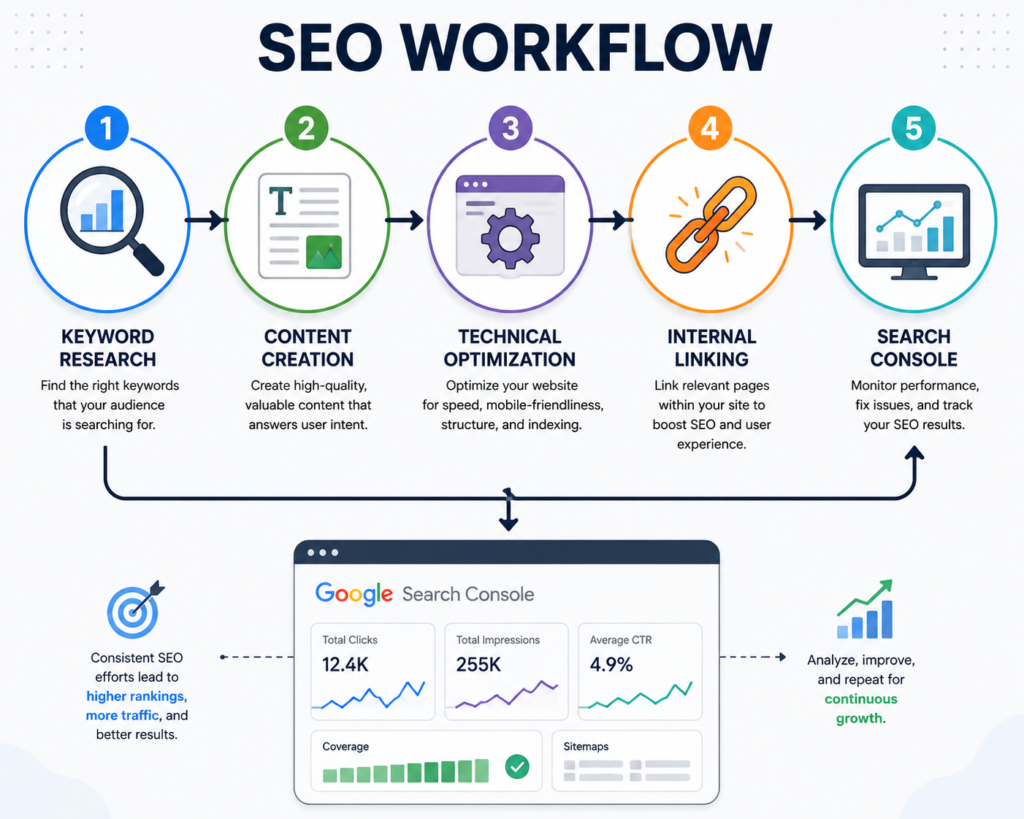
Step 8: Use Search Console
Google Search Console is a free tool that helps website owners understand how their site performs in Google Search and troubleshoot indexing or search-related problems.
It can help you understand which queries bring impressions and clicks, identify indexing problems, inspect individual URLs, and monitor search performance.
Best SEO Practices for 2026
SEO continues to evolve, but several principles remain important.
Prioritize People-First Content
Google states that its automated ranking systems are designed to prioritize helpful and reliable information created for people rather than content created mainly to manipulate search rankings.
Before publishing an article, ask:
Would I still want to publish this page if search engines did not exist?
If the answer is no, the content strategy may need reconsideration.
Make the Main Topic Clear
Readers should quickly understand what the page is about.
Use descriptive titles, headings, introductory paragraphs, and relevant supporting information.
Demonstrate Trust
Where appropriate, explain who created the content and provide useful background about the author or organization.
Google’s people-first guidance recommends making authorship clear through accurate bylines and author information where appropriate.
Keep Information Accurate
Do not invent statistics, research, expert opinions, or claims.
For important topics, use reliable sources and clearly distinguish factual information from opinion or interpretation.
Improve User Experience
A page should be readable, usable, secure, and accessible across devices.
Google’s developer documentation specifically recommends that websites be secure, fast, accessible, and work across devices.
Common SEO Mistakes to Avoid
1. Writing Only for Search Engines
A common mistake is creating content because a keyword appears valuable rather than because the topic is genuinely useful to the audience.
Google explicitly warns against search-engine-first content.
2. Keyword Stuffing
Repeating a keyword excessively can make content unnatural.
Write for people first and cover the topic naturally.
3. Publishing Thin Content
An article that answers only one sentence of a complex question may leave readers searching elsewhere.
The better approach is to provide enough context and practical information to satisfy the intended search.
4. Copying Other Websites
Simply rewriting existing articles does not automatically make content valuable.
Google asks creators to add substantial originality and value rather than simply copying or rewriting other sources.
5. Chasing Guaranteed Rankings
Nobody can legitimately guarantee a specific Google ranking.
Google warns website owners to be skeptical of SEOs who promise guaranteed number-one rankings or claim a special relationship with Google.
6. Ignoring Technical Problems
Excellent writing cannot help much if search engines cannot access the page properly.
Problems with servers, network access, robots.txt rules, indexing directives, or website configuration can affect how Google processes pages.
7. Forgetting Search Intent
A page can target the right words but still fail because it provides the wrong type of information.
Always consider what the searcher expects.
Real-World SEO Example
Imagine a small technology website publishes an article titled:
What Is Artificial Intelligence?
The website could improve the article by:
- Clearly defining artificial intelligence near the beginning.
- Explaining machine learning and deep learning.
- Providing real-world examples.
- Using descriptive headings.
- Linking to related technology articles.
- Adding useful illustrations with descriptive alt text.
- Using a readable URL such as
/what-is-artificial-intelligence/. - Monitoring the page through Google Search Console.
- Updating the article when important information changes.
Notice that none of these steps require stuffing the phrase “what is artificial intelligence” into every paragraph.
The goal is to make the page genuinely useful and easy to understand.
SEO vs. Paid Search
SEO and paid search are different.
SEO focuses on organic search visibility.
Paid search advertising involves paying for advertising placements.
Google states that paying for advertising does not affect a site’s presence in Google’s organic search results.
A business may use both approaches, but they serve different purposes.
SEO can be a long-term strategy for building organic visibility, while paid advertising can provide visibility through advertising campaigns.
How Long Does SEO Take?
There is no universal amount of time required for SEO to work.
Google does not guarantee that pages will be crawled, indexed, or served in search results, even when sites follow its guidance.
Results can depend on factors such as:
- Website history
- Competition
- Content quality
- Technical health
- Search demand
- Site architecture
- Existing authority
- How quickly search engines discover and process changes
This is why SEO should be treated as an ongoing process rather than a one-time action.
Frequently Asked Questions
What does SEO stand for?
SEO stands for Search Engine Optimization. It refers to practices that help search engines understand website content and help users discover relevant pages through search.
What is the main purpose of SEO?
The main purpose is to improve a website’s visibility and usefulness in organic search while making its content easier for search engines to discover and understand.
Is SEO free?
Organic search traffic does not require paying Google for placement. However, SEO can require time, technical work, content creation, research, tools, or professional services. Google states that it does not charge sites to appear in organic search results.
Does SEO guarantee the first position on Google?
No. Google explicitly states that there are no automatic secrets or guaranteed methods for ranking first.
Is SEO only about keywords?
No. SEO also involves content quality, search intent, website structure, crawling, indexing, links, page experience, technical accessibility, and other factors.
What is technical SEO?
Technical SEO focuses on helping search engines access, crawl, process, and understand a website. It can include areas such as sitemaps, indexing controls, URLs, canonicalization, security, and website architecture.
What is on-page SEO?
On-page SEO involves optimizing elements on individual webpages, including content, headings, titles, URLs, internal links, and image information.
Can a small website benefit from SEO?
Yes. A small site can use SEO fundamentals to make its content easier to discover and understand. Google recommends its SEO Starter Guide as a practical starting point for website owners.
Final Thoughts
So, what is SEO?
SEO is the process of improving a website so search engines can better understand its content and users can more easily discover useful pages through organic search.
The fundamentals are easier to understand when you stop thinking about SEO as a trick for manipulating rankings.
Good SEO starts with a useful website.
Create content that answers real questions. Organize the website clearly. Use descriptive titles and URLs. Make important pages discoverable. Connect related content with internal links. Pay attention to technical accessibility. Monitor performance with tools such as Google Search Console. Most importantly, make sure the reader gets genuine value from every page.
Google’s current guidance consistently emphasizes this people-first approach: content should be useful, reliable, original, and created primarily to help people rather than to manipulate search rankings.
SEO can support that goal by making genuinely useful content easier for search engines to discover and understand.
These should be existing or future HanadReview articles only when they genuinely help readers understand SEO, following the prompt’s internal-linking requirement.