
What Is Artificial Intelligence? How AI Works, Benefits, Examples & the Future in 2026
IntroductionYou probably use artificial intelligence more often than you realize.
When your phone recognizes your voice, a streaming service recommends something you might enjoy, an email system filters unwanted messages, or an AI chatbot answers a question, artificial intelligence may be working behind the scenes.
That can make AI sound more mysterious than it really is.
So, what is artificial intelligence?
In simple terms, artificial intelligence is a broad field of technology focused on building computer-based systems that can process information and produce useful outputs such as predictions, recommendations, classifications, decisions, or generated content. NIST describes an AI system as a machine-based system that can make predictions, recommendations, or decisions based on human-defined objectives.
This guide explains artificial intelligence from the ground up. You will learn what AI means, how it works, how machine learning and deep learning fit into the picture, where AI is being used, what its benefits and limitations are, and what the technology could mean in the years ahead.
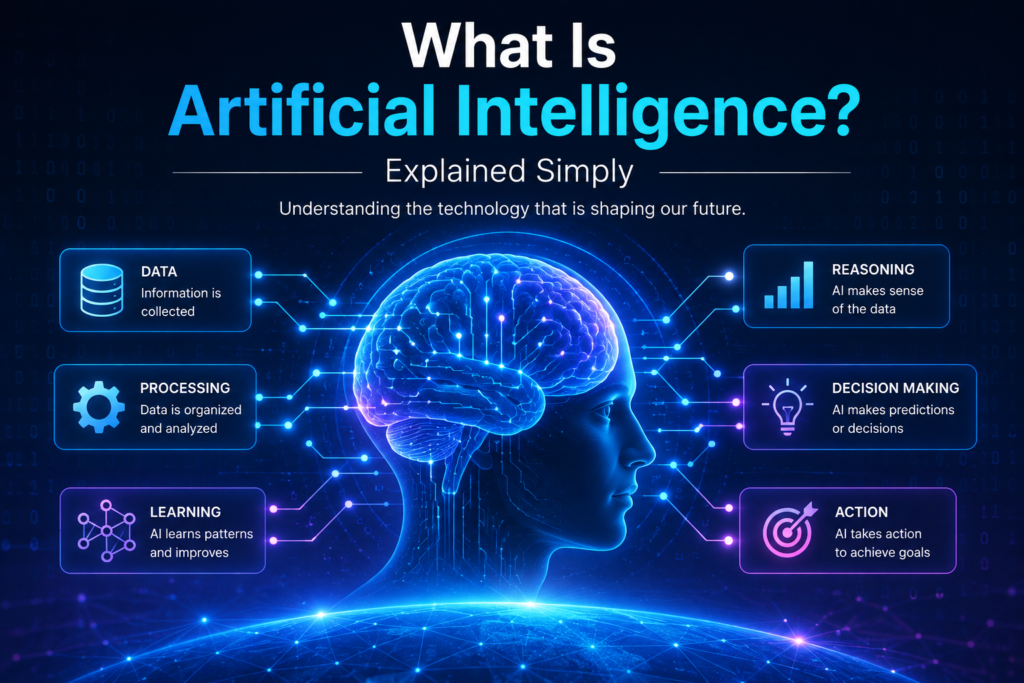
What Is Artificial Intelligence?
Artificial intelligence (AI) is a broad area of computing concerned with creating systems that can perform tasks that involve capabilities such as recognizing patterns, processing language, making predictions, recommending actions, or generating content.
There is no single type of AI.
Some AI systems are built to identify objects in photographs. Others translate languages, detect unusual transactions, recommend videos, analyze data, or generate text.
That is why it is better to think of AI as an umbrella term rather than the name of one specific technology.
A useful way to look at it is this:
Artificial intelligence takes information, processes it using computational methods, and produces an output that can help accomplish a particular objective.
For example, imagine an email service trying to identify spam.
It can examine patterns in messages and use an AI model to estimate whether a new message is likely to be unwanted. The system can then place that message in a spam folder.
The computer is not “thinking” about spam exactly as a person would. It is using computational methods to recognize patterns and produce a result.
That distinction is important because it helps separate what AI actually does from the way AI is sometimes portrayed in movies and popular culture.
Why Is Artificial Intelligence Important?
AI has become important because it can help people and organizations handle tasks that involve large amounts of information, repeated decisions, pattern recognition, and content processing.
The technology is also developing quickly. Stanford’s 2026 AI Index reports continued progress in AI capabilities, growing adoption, and increasing integration of AI into areas such as the economy, science, education, medicine, and public policy. At the same time, the report highlights a widening gap between the pace of technical development and society’s ability to evaluate and govern AI effectively.
For an ordinary user, that matters because AI is increasingly becoming part of everyday software.
You may not always see an obvious “AI” label, but AI can appear inside:
- Search and recommendation systems
- Smartphones and voice assistants
- Translation tools
- Customer-support systems
- Security software
- Educational applications
- Business analytics platforms
- Creative software
- Healthcare technologies
The practical question is therefore not simply whether AI is important.
It is how AI works, where it is useful, and where people still need to be careful.
How Does Artificial Intelligence Work?
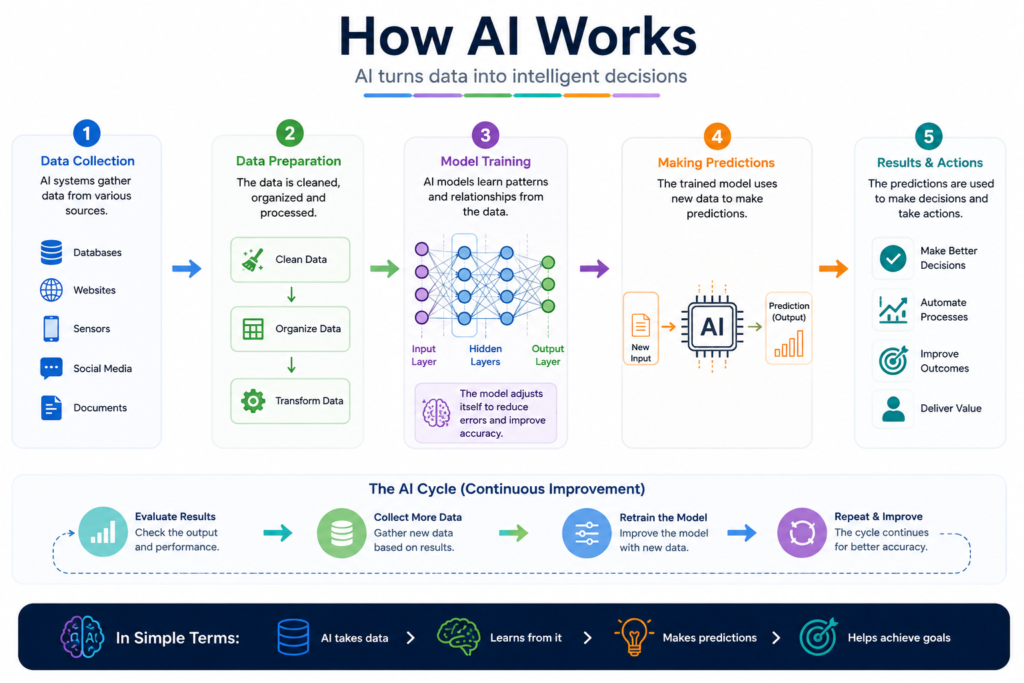
The details vary from one AI system to another, but a simplified AI process can be described as:
Input → Data/Information → AI Model → Processing → Output
Let’s break that down.
1. Input
The system receives information.
That could be:
- Text
- An image
- Audio
- Numbers
- Sensor readings
- User behavior
- Documents
2. Data
Many modern AI systems depend heavily on data. Data can be used during development and training so that a model can learn useful patterns.
For example, a system designed to classify images might be developed using large collections of images that have been labeled according to what they contain.
3. AI Model
The model is the computational component that processes information and produces an output.
Different models are built for different purposes.
One model may classify an image. Another may predict a value. Another may generate text.
NIST distinguishes AI systems from individual models: an AI system can include software, hardware, applications, tools, or utilities that operate partly or wholly using AI.
4. Processing
The model analyzes the input using the methods it was designed or trained to use.
The exact process can be highly technical, but the basic idea is straightforward: the system looks for patterns or relationships that can help it produce an appropriate output.
5. Output
The final result might be:
- A prediction
- A recommendation
- A classification
- A generated response
- A warning
- A decision-support result
For instance, a banking system could flag a transaction as potentially suspicious. A recommendation system could suggest a video. A language model could generate a paragraph based on a user’s instruction.
What Is Machine Learning?
Machine learning (ML) is one of the most important approaches used in artificial intelligence.
Instead of having developers write a separate rule for every possible situation, machine-learning systems can learn patterns from data and use those patterns when processing new information.
Imagine you want to build a system that can distinguish between two categories of messages.
A traditional rule-based system might rely heavily on manually written conditions.
A machine-learning system can instead be trained using examples. From those examples, the model can learn patterns that are useful for making predictions about new messages.
That does not mean the model understands the messages in the same way a human does. It means the computational process has learned statistical relationships that can help it perform the task.
Machine learning is therefore best understood as a way of building AI systems by allowing models to learn useful patterns from data.
What Is Deep Learning?
Deep learning is a specialized form of machine learning that uses multilayer neural networks to learn complex patterns.
It has become especially important for tasks involving:
- Images
- Speech
- Video
- Natural language
- Complex pattern recognition
A deep-learning model can contain many layers that transform information step by step.
You do not need to understand every mathematical detail to understand the main idea.
Think of it this way:
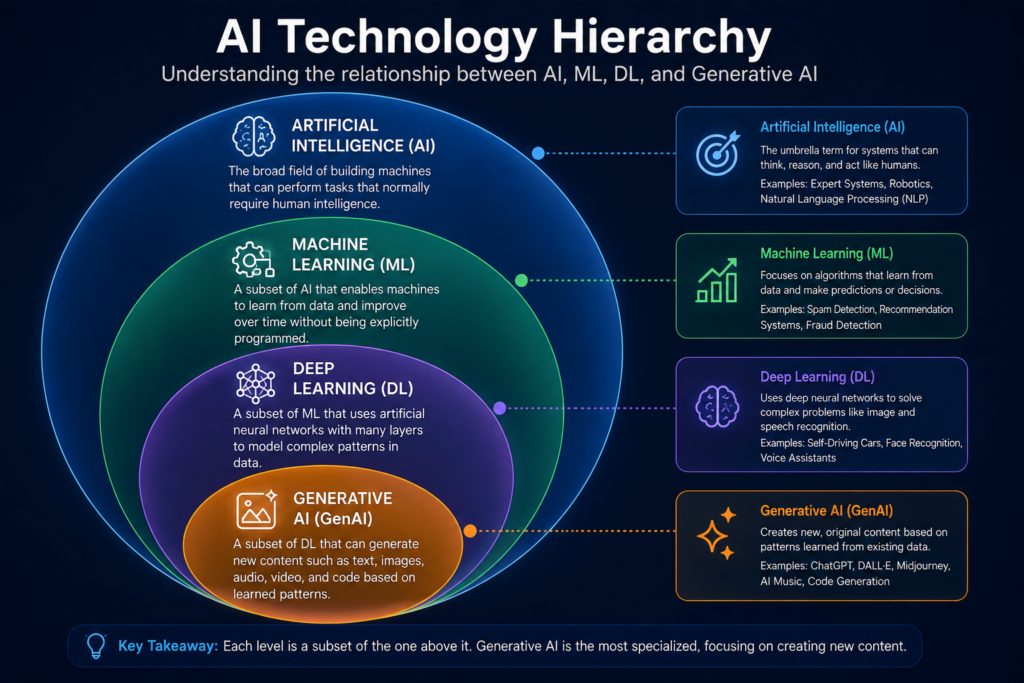
Machine learning is a broad approach to learning from data. Deep learning is one specialized approach within machine learning that uses multilayer neural networks.
That makes the relationship easier to remember:
AI → Machine Learning → Deep Learning
Deep learning is therefore part of the larger AI family rather than a completely separate technology.
What Is Generative AI?
You may have heard the term generative AI frequently in recent years.
Generative AI refers to AI systems designed to generate new content.
Depending on the system, that content can include:
- Text
- Images
- Audio
- Video
- Computer code
- Other forms of digital content
NIST describes generative AI as a class of AI models capable of generating synthetic content derived from patterns in input data.
A simple example is a system that receives an instruction such as:
Explain photosynthesis to a 12-year-old.
A generative AI model can produce a new response based on patterns learned during its development.
That is different from a conventional search engine simply retrieving a page from a database.
Generative AI can also create images from text descriptions, summarize documents, transform existing writing, assist with programming, and perform many other content-related tasks.
However, there is an important limitation:
An AI-generated answer can sound convincing and still be wrong.
That is one reason verification matters.
What Are the Main Types of Artificial Intelligence?
There are several ways to classify AI. One common approach focuses on how broad the system’s capabilities are.
Narrow AI
Narrow AI, sometimes called specialized AI, is designed for particular tasks or limited categories of tasks.
Examples include:
- Speech recognition
- Recommendation systems
- Image classification
- Fraud detection
- Translation
- Customer-service automation
Most AI applications people interact with today fit within this general category.
Artificial General Intelligence
Artificial General Intelligence (AGI) is generally used to describe a hypothetical form of AI that could handle a broad range of intellectual tasks with a much more general level of flexibility.
AGI should not be confused with an AI system that is extremely capable at one particular task.
A system can be excellent at image recognition, text generation, or mathematical problems without being a generally capable human-like intelligence.
Artificial Superintelligence
Artificial superintelligence is another hypothetical concept. It refers to a possible future AI system whose intellectual capabilities would exceed human capabilities across a very broad range of areas.
It remains a theoretical concept rather than an ordinary technology that people routinely use today.
Where Is Artificial Intelligence Used?
AI is not limited to chatbots.
It is used or researched across many different fields, although the specific applications and level of human oversight can vary greatly.
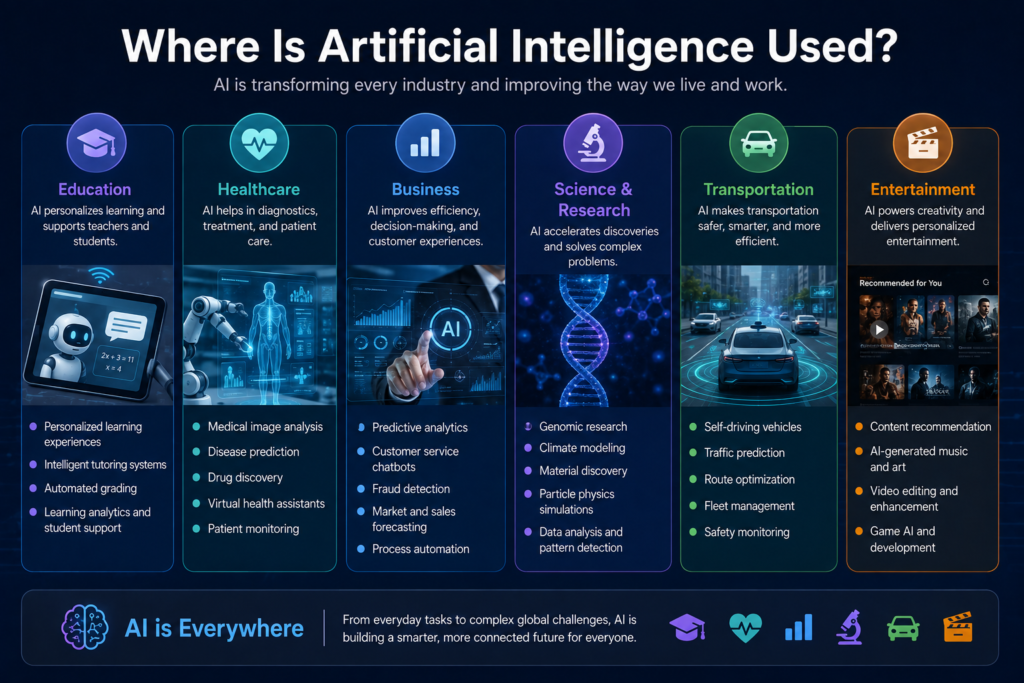
Artificial Intelligence in Education
AI can be used in education for activities such as tutoring support, personalized learning, lesson planning, feedback, translation, accessibility, and administrative assistance.
UNESCO’s work on AI competency emphasizes that students need more than the ability to operate AI tools. They also need knowledge of AI techniques, ethics, responsible use, and the ability to critically evaluate AI systems.
That is an important distinction.
The goal should not simply be to teach students how to ask an AI system for answers. Students also need to understand when those answers should be questioned.
Artificial Intelligence in Healthcare
AI can support areas such as medical research, image analysis, data processing, clinical workflows, and administrative tasks.
Because healthcare decisions can have serious consequences, AI systems used in this environment require appropriate validation and human oversight.
A useful principle is simple:
AI can support healthcare professionals, but important health decisions should not automatically be delegated to an AI system.
Artificial Intelligence in Business
Businesses use AI for a wide range of tasks, including:
- Customer support
- Data analysis
- Document processing
- Forecasting
- Fraud detection
- Workflow automation
- Recommendation systems
For a small business, for example, AI might help organize customer messages or summarize large documents.
For a larger organization, AI could become part of a much more complex system involving data analysis, forecasting, customer operations, and internal workflows.
Artificial Intelligence in Transportation
AI can contribute to:
- Navigation
- Route planning
- Traffic prediction
- Driver-assistance features
- Image and sensor interpretation
- Research into autonomous systems
The more safety-critical the application becomes, the more important testing, monitoring, and appropriate human control become.
Artificial Intelligence in Science
Scientific research is another area where AI is becoming increasingly important.
Stanford’s 2026 AI Index includes dedicated analysis of AI in science, medicine, and other research fields, reflecting how deeply the technology is becoming integrated with scientific work.
Researchers can use AI to analyze large datasets, identify patterns, assist with computational experiments, and explore questions that would be difficult to investigate manually at the same scale.
What Are the Benefits of Artificial Intelligence?
AI can provide real advantages when it is used for the right task and managed carefully.
Faster Information Processing
Computers can process large amounts of information rapidly.
This can be valuable when people would otherwise need to sort through thousands or millions of records manually.
Automation
AI can automate repetitive or predictable tasks.
For example, a system could classify documents, process routine requests, or identify patterns that need further attention.
Automation does not necessarily mean removing people from the process. In many cases, it means allowing people to spend less time on repetitive work.
Pattern Recognition
Humans can be very good at recognizing patterns, but there are situations where the amount of available data makes manual analysis difficult.
AI models can process large datasets and identify relationships that may be useful for prediction or classification.
Personalization
AI can help tailor digital experiences based on user behavior or preferences.
This can include recommendations, learning experiences, search results, and other types of software interaction.
Accessibility
AI can also support accessibility through technologies such as:
- Speech recognition
- Automatic transcription
- Translation
- Image descriptions
- Text generation
- Voice interaction
Used responsibly, these systems can make information and digital tools easier to access for many people.
What Are the Disadvantages and Risks of AI?
AI has useful capabilities, but it also comes with important limitations.
Understanding those limitations is essential for using the technology responsibly.
AI Can Produce Incorrect Information
One of the most important problems is that AI systems can generate incorrect or misleading outputs.
This is especially important with generative AI.
A response can be grammatically excellent and sound confident while containing factual mistakes.
That means users should not confuse fluency with accuracy.
AI Can Reflect Bias
AI systems can be influenced by patterns in their data, design, evaluation methods, or deployment environment.
This can lead to unfair or undesirable results in some circumstances.
Responsible AI therefore involves more than improving performance. It also involves considering fairness, safety, transparency, and accountability.
Stanford’s 2026 AI Index specifically tracks responsible-AI development and highlights that evaluation and reporting have not always kept pace with advances in AI capabilities.
Privacy Can Be a Concern
AI systems may process large amounts of information.
Depending on the application, that information can include data that should be treated carefully.
Before entering sensitive information into an AI application, users should understand what data they are sharing and what rules apply to its use.
Security Risks
AI can also create new security challenges.
Systems can be attacked, manipulated, misused, or poorly integrated into larger software environments.
That is why AI security needs to be considered during development and deployment rather than treated as an afterthought.
AI Can Change Jobs and Workflows
AI can automate some tasks and change how people perform their jobs.
The effect is unlikely to be identical everywhere.
Some tasks may become automated. Other jobs may involve more AI-assisted work. New responsibilities can also emerge around checking, supervising, integrating, and managing AI systems.
Stanford’s 2026 AI Index treats labor-market and economic effects as significant parts of the broader AI story.
AI vs. Machine Learning vs. Deep Learning vs. Generative AI
These terms are related, but they should not be used interchangeably.
| Technology | Meaning | Simple Example |
|---|---|---|
| Artificial Intelligence | Broad field involving systems that perform tasks associated with intelligent behavior | A system that detects suspicious transactions |
| Machine Learning | A major AI approach that learns patterns from data | Predicting whether a transaction may be unusual |
| Deep Learning | A machine-learning approach using multilayer neural networks | Recognizing objects in images |
| Generative AI | AI designed to generate new content | Producing text or an image from an instruction |
The easiest way to remember the relationship is:
AI is the broad category. Machine learning is one major approach within AI. Deep learning is a type of machine learning. Generative AI refers to systems designed to generate content.
This distinction becomes especially useful when reading about AI because technology companies and media outlets sometimes use these terms loosely.
A Simple Real-World Example of AI
Let’s make the idea even simpler.
Imagine you visit an online store and look at several products.
The store already has information about products, customer activity, and previous interactions.
An AI-based recommendation system can process relevant patterns and estimate which products may be useful to you.
The simplified process might look like this:
Your activity → Data → AI model → Prediction → Recommendation
The system does not need a human employee to choose every recommendation manually.
Instead, the model uses computational patterns to produce suggestions based on the objective it was designed to accomplish.
This same general idea appears in many other applications.
A spam filter predicts whether an email belongs in the spam category.
A fraud-detection system estimates whether a transaction looks unusual.
A speech-recognition system processes audio and produces text.
A generative AI system processes an instruction and generates content.
The tasks are different, but the broad idea of transforming input into useful output remains similar.
How to Use AI Responsibly
Getting useful results from AI is not only about knowing what to type.
It is also about knowing what to trust and what to check.
Verify Important Information
For ordinary brainstorming, a small mistake may not matter much.
For health, financial, legal, educational, or safety-related information, accuracy matters much more.
Check important claims against trustworthy sources.
Protect Sensitive Information
Think carefully before sharing private information with any AI application.
Avoid entering confidential information unless you understand how it will be handled and you have the right to share it.
Use AI as an Assistant
AI can help with research, brainstorming, organization, drafting, summarization, and many other activities.
But using AI as an assistant is different from treating it as an unquestionable authority.
Human judgment still matters.
Give Clear Instructions
The clearer your objective, context, and constraints are, the easier it is for an AI system to produce a useful result.
Instead of:
“Write about AI.”
A stronger instruction might be:
“Explain artificial intelligence to a beginner in 1,000 words, using simple examples and a short comparison between AI and machine learning.”
The second instruction gives the system a much clearer job.
Review the Final Result
Before publishing or relying on AI-generated material, review it.
Look for:
- Incorrect facts
- Missing context
- Unsupported claims
- Repetition
- Strange wording
- Bias
- Outdated information
This step is particularly important when the final content will be used publicly.
Common Mistakes Beginners Make With AI
Assuming AI Is Always Correct
An AI answer is not automatically a verified answer.
Treat important claims as information that may need checking.
Thinking AI Works Like a Human Brain
The comparison between AI and the human brain can be useful for explaining certain concepts, but it can also become misleading.
AI systems process information using computational models. That does not mean they operate exactly like a human mind.
Confusing Generative AI With All AI
Generative AI has attracted enormous attention, but it is only one part of the wider AI field.
AI also includes systems built for prediction, classification, recommendations, perception, optimization, and other tasks.
Giving Vague Instructions
Very broad prompts often lead to generic answers.
Clear instructions usually make the intended task easier to understand.
Ignoring Privacy
Users sometimes focus on what AI can do and forget to consider what information they are giving it.
The ability to process information does not automatically mean every type of information should be shared.
What Is the Future of Artificial Intelligence?
It is difficult to predict exactly what AI will look like several years from now.
What is easier to establish is that the technology is continuing to develop rapidly.
Stanford’s 2026 AI Index reports major advances in AI performance while also pointing to challenges around evaluation, transparency, responsible AI, governance, and public understanding.
That means the future of AI is not simply a race to build increasingly powerful models.
It is also a question of how those systems are used.
Some of the biggest questions include:
- How accurate should an AI system be before people rely on it?
- How should AI-generated information be verified?
- How can private information be protected?
- How should AI systems be tested for safety?
- Who is responsible when an AI system causes harm?
- How should people remain involved in high-impact decisions?
- How should students and workers learn to use AI responsibly?
Education will play an important role here.
UNESCO’s AI competency framework for students emphasizes human-centered thinking, ethics, technical understanding, and AI system design, with the goal of helping learners become responsible users and creators of AI.
In other words, understanding AI will increasingly mean more than knowing how to use an AI tool.
It will mean knowing what the tool is doing, what it cannot do, and when its output should be questioned.
Frequently Asked Questions About Artificial Intelligence
What is artificial intelligence in simple words?
Artificial intelligence is technology that enables computer-based systems to process information and perform tasks such as prediction, classification, recommendation, language processing, and content generation.
Is AI the same as machine learning?
No. AI is the broader field, while machine learning is one major approach used to build AI systems that learn patterns from data.
What is generative AI?
Generative AI is a category of AI designed to generate new content such as text, images, audio, video, or code.
Can artificial intelligence make mistakes?
Yes. AI systems can produce inaccurate, incomplete, biased, or misleading results. Important information should therefore be verified.
Is AI smarter than humans?
That question is too broad to have one simple answer. AI systems can outperform people in certain specific tasks, while humans remain much more flexible across many different real-world activities.
Is artificial general intelligence available today?
AGI is generally used to describe a hypothetical form of broadly capable AI. It should not be confused with specialized AI systems that can perform impressive but narrower tasks.
Why is AI important in 2026?
AI is becoming increasingly integrated into technology, business, science, education, and other areas. At the same time, questions about safety, accuracy, transparency, governance, and responsible use are becoming more important.
Should students use AI?
Students can use AI as a learning aid when it supports understanding rather than replacing their own thinking. UNESCO emphasizes the importance of developing AI literacy, critical judgment, ethics, and responsible use among students.
Final Thoughts
Artificial intelligence is not one single machine, application, or chatbot.
It is a broad field of technology that includes systems capable of processing information and producing outputs such as predictions, recommendations, classifications, decisions, and generated content.
Within that larger field, machine learning provides an important way for systems to learn patterns from data. Deep learning is a specialized machine-learning approach based on multilayer neural networks. Generative AI focuses on creating new digital content.
The technology can be extremely useful.
It can help people process information, automate repetitive tasks, identify patterns, improve accessibility, support scientific research, and interact with software in new ways.
But AI also has limits.
It can make mistakes. It can reflect bias. It can create privacy and security concerns. And it can change how people work and learn.
That is why learning about AI should not be about blindly accepting it or automatically fearing it.
The better approach is to understand it.
Know what AI can do. Know what it cannot do. Verify important information. Protect sensitive data. And keep human judgment involved when the consequences matter.
For readers who want to continue learning, the next useful topics are machine learning, generative AI, large language models (LLMs), AI agents, and how AI chatbots actually work.
What Is Digital Marketing? A Complete Beginner's Guide for 2026
[…] Digital Marketing and Artificial Intelligence […]