
Manus AI Review 2026: Is It Legit or a Scam? Honest Expert Analysis

Quick Summary Box
| Product | Manus AI (autonomous AI agent) |
| Company | Butterfly Effect Pte. Ltd. |
| Launched | March 2025 |
| Starting Price | Free (300 daily credits); paid plans from $20/month |
| Best For | Solo researchers, indie builders, agencies needing a hands-off research/prototyping agent |
| Avoid If | You need predictable billing, fast refunds, or a production-ready coding partner |
| Our Overall Rating | 6.3 / 10 |
| Trustpilot Sentiment | Largely negative — a pattern of billing and refund complaints (see Customer Reviews section) |
Transparency Note
This review is based on publicly available information current as of August 2026, including the official Manus website, third-party pricing trackers, and publicly posted customer reviews on Trustpilot. Pricing, features, and ownership details change frequently for this product — always confirm current terms on manus.im before purchasing. We have not used or been compensated by Manus for this review, and we do not fabricate testimonials; all customer sentiment referenced below is summarized from publicly visible reviews.
Introduction
If you’ve spent any time in AI communities over the past year, you’ve seen the name Manus AI everywhere. It’s been called the first true “general AI agent,” praised for building websites and writing research reports without step-by-step hand-holding, and — just as loudly — criticized on Trustpilot and Reddit for confusing credit pricing and slow refunds.
So which is it?
This review is for anyone weighing a Manus AI subscription in 2026: freelancers evaluating it as a research assistant, founders considering it to prototype an app, and agencies wondering whether it’s stable enough to build client work on. You’ll learn exactly what Manus AI is, how it works, what it really costs once credits are factored in, what actual customers say about billing and support, how it stacks up against alternatives like Genspark, ChatGPT Agent, and Devin, and — most importantly — whether it deserves your money and your trust.
We’ll keep this balanced. Manus AI has genuinely impressive capabilities. It also has a well-documented pattern of customer complaints that you should know about before you enter a credit card number.
What Is Manus AI?
Manus is an autonomous AI agent — software that plans and executes multi-step tasks such as research, coding, and data analysis rather than only producing conversational responses. Instead of answering one question at a time like a chatbot, you give Manus a broad goal (“research my competitors and build me a comparison slide deck”) and it works through the task independently inside its own cloud-based virtual computer, only returning to you with a finished deliverable.
Mission and Positioning
Manus positions itself as a “general-purpose AI agent” rather than a narrow tool for one job. Its stated goal is to close the gap between “AI that talks” and “AI that actually does the work” — competing less with chatbots and more with the idea of hiring a junior analyst, researcher, or developer.
Industry
Manus sits in the fast-growing autonomous AI agent category, a segment distinct from conversational assistants (ChatGPT, Claude, Gemini) and from narrow automation tools (Zapier, Make). According to industry data cited by competitor-analysis sites, <cite index=”30-1″>the AI agents market is projected to grow from USD 5.1 billion in 2024 to USD 47.1 billion by 2030, which explains why so many companies — Manus included — are racing to define the category.
Company and Location
Manus is built by Butterfly Effect Pte. Ltd., a company whose operational headquarters is in Singapore, with additional offices in Tokyo and San Francisco, and roughly 105 employees as of December 2025. The company’s roots, however, are Chinese: Xiao Hong founded Butterfly Effect in Beijing in 2022, two months before OpenAI publicly launched ChatGPT, initially keeping offices in Beijing and Wuhan and targeting consumers in North America, Japan, and South Korea.
Global Presence
Manus markets itself primarily to Western and APAC customers rather than the Chinese domestic market. A planned Chinese-market version of Manus, developed in partnership with Alibaba’s Qwen team, was shelved when the company pivoted away from mainland China a notable detail for anyone curious about the product’s true target audience.
Company History and Founders
Understanding who built Manus — and how fast the company has moved — matters for judging how stable the product is likely to be.
The Founding Team
- Xiao Hong (肖弘) founder and CEO of Butterfly Effect, who founded the company in 2022 and had previously built the Monica browser extension.
- Ji Yichao (季逸超), nicknamed “Peak” — co-founder and chief scientist, born in 1992 and raised in Colorado and Beijing, who studied computer science in Beijing and built the Mammoth Browser for iPhone while still in high school He founded Peak Labs in 2012 with backing from ZhenFund and Sequoia China and was named to Forbes China’s 30 Under 30 in both 2012 and 2013.
- Zhang Tao — co-founder and product director.
From Browser Extension to AI Agent
Before Manus existed, the same team built Monica, an AI browser plugin that integrated multiple leading language models — Claude, GPT-4o, DeepSeek, and Gemini — behind one sidebar interface, and quickly gathered more than a million users, mostly in overseas markets. That experience shipping a consumer AI product globally directly shaped Manus.
In 2024, the Monica team began experimenting with autonomous agents, betting that the next wave after chatbots would be agents that took real actions rather than just generating text. Ji Yichao and Zhang Tao joined as co-founders, and the team began building Manus in October 2024, drawing direct inspiration from the AI coding tool Cursor.
Rapid Growth — and a Blocked Acquisition
Manus launched to the public in March 2025 and grew extraordinarily fast. By December 2025, Manus had crossed $100 million in annual recurring revenue, right around the same time Meta agreed to acquire Butterfly Effect for a reported $2 billion-plus. That deal briefly made Manus one of the most talked-about acquisitions in AI.
It didn’t hold. Four months later, China’s regulator blocked the deal on national-security grounds, and by June 2026 Meta had begun unwinding it, cutting off data access and winding down the integration while Manus’s founders explored buying the company back. As of this review, ownership of Manus remains unresolved, though the product itself continues to operate and ship new features.
This matters for buyers: you’re subscribing to a product whose corporate ownership has been genuinely unsettled for months. That’s worth factoring into any long-term commitment.
Key Features Explained
1. Autonomous Multi-Step Task Execution
What it does: You give Manus one high-level instruction, and it independently plans, researches, and executes every step needed to complete it — without asking for approval at each stage.
Benefit: Saves the back-and-forth of prompting a chatbot dozens of times for one project.
Real-world use case: A marketer asks Manus to analyze five competitor websites and produce a positioning report; Manus browses each site, extracts data, and returns a formatted document.
Pros: Genuinely reduces manual effort on research-heavy tasks. Cons: Autonomy means less visibility into what’s happening mid-task, and errors can compound before you notice them.
2. Multi-Agent Architecture
Manus doesn’t rely on a single model handling everything. It runs a coordinated system of specialized sub-agents — one focused on planning, another on execution, others on specific tool use — that work together on a shared task.
Benefit: Complex tasks get broken into manageable pieces handled by the right sub-process. Con: More moving parts also means more places for something to go wrong, which lines up with user complaints about tasks getting “stuck in loops.”
3. Web App Builder
Manus now includes a Web App Builder that creates full websites and apps complete with a database, Stripe payment integration, and SEO configuration
Benefit: Non-technical founders can go from an idea to a live, monetizable web app without hiring a developer. Con: Trustpilot reviewers have reported serious deployment failures, including sites that build correctly in the editor but fail to load once deployed to a custom domain — so treat any output as something to test thoroughly, not something to trust blindly in production.
4. Wide Research (Parallel Sub-Agents)
Heavy batch research work fans out across parallel sub-agents through a feature called Wide Research, letting Manus tackle large research jobs faster than a single linear agent could.
Benefit: Good for large-scale, repetitive research tasks (e.g., analyzing hundreds of companies at once). Con: Parallel sub-agent tasks can consume credits very quickly, and Manus does not show the credit cost before you commit to a task.
5. Desktop App and “My Computer”
Manus launched a desktop app in March 2026 with a feature called “My Computer,” letting the agent execute terminal commands, read local files, and use installed developer tools directly on your machine
Benefit: Bridges the gap between a purely cloud-based agent and one that can act on your own local environment. Con: Granting an AI agent terminal and file-system access on your personal computer raises legitimate security questions that cautious users should weigh carefully.
6. Model Flexibility
Manus is not built on a single proprietary model. It relies on Anthropic’s Claude for core reasoning and fine-tuned Alibaba Qwen models for specialized tasks, and as of mid-2026 runs on what’s referred to as the “1.6” model family (1.6 Lite, 1.6, and 1.6 Max) with improved multi-step reasoning.
Benefit: Combining frontier models can produce stronger results than relying on one model alone. Con: Model-mixing also makes behavior harder to predict task to task.
How Manus AI Works (Step by Step)
You submit a goal, not a single question. Example: “Build me a landing page with a waitlist form and SEO basics.”
- Manus creates a plan. The system breaks your goal into an internal sequence of steps.
- Manus spins up a virtual computer. Each task runs inside an isolated cloud environment where the agent can browse, code, and run commands.
- Sub-agents execute the plan. Different specialized processes handle research, writing, coding, or design as needed.
- You can monitor or step away. Manus reports on progress but is designed to run largely unattended.
- You receive a finished deliverable. A website, document, spreadsheet, or slide deck — not just a text answer.
- You review, revise, or redeploy. Given the deployment issues reported by users, this review step is essential before using any output for a live product or client.
Manus AI Pricing 2026
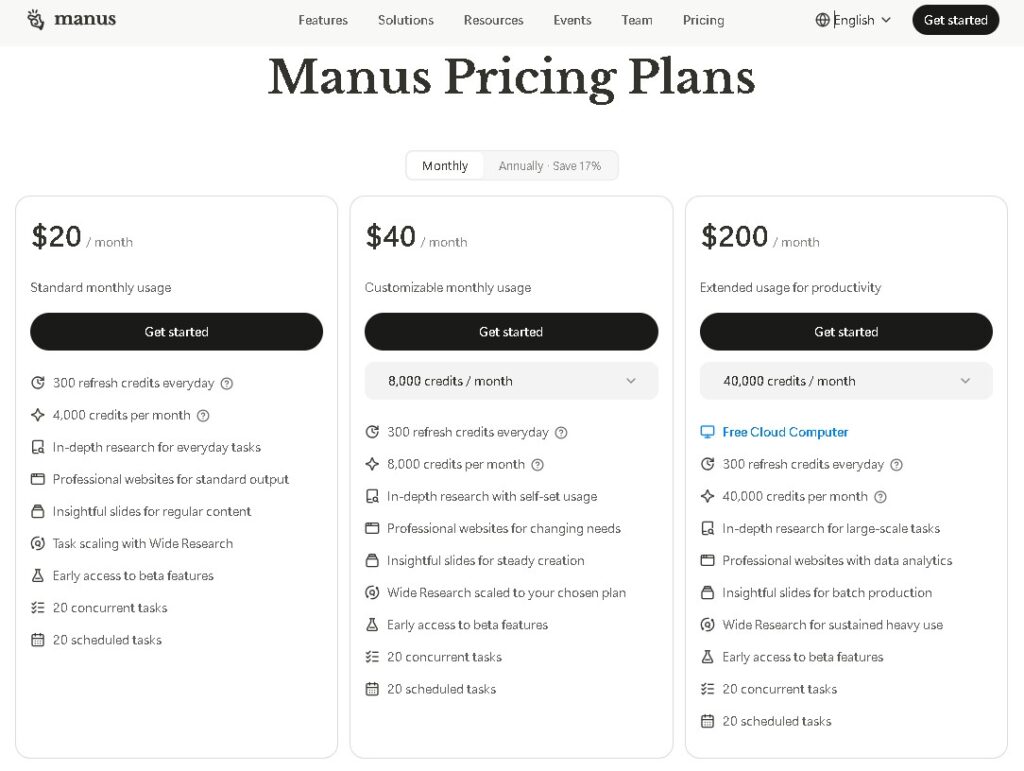
Manus does not charge per seat or per query — it charges by credits, which are consumed based on task complexity.
Current Plans
| Plan | Price | Credits | Notes |
|---|---|---|---|
| Free | $0/month | 300 daily refresh credits | Supports up to 5 concurrent tasks; no credit card required |
| Pro (Entry) | $20/month | 4,000 monthly credits | Good for light individual use |
| Pro (Mid) | $40/month | 8,000 monthly credits, includes a 7-day free trial | Most popular individual tier |
| Pro (Top) | $200/month | 40,000 monthly credits | For heavy, frequent agent workflows |
| Team | From $20 per seat/month | Shared credit pool | Adds SSO, analytics, and access controls |
Additional pricing facts:
- Annual billing saves 17% across every paid tier
- Monthly credits do not roll over, though purchased add-on credits remain usable as long as your paid subscription stays active
- A single deep-research task can consume 900 to 1,000-plus credits, and Manus does not display the cost of a task before you run it
Hidden Fees and Refund Concerns
This is where prospective buyers should pay closest attention. Multiple Trustpilot reviewers describe unexpected charges, credits being deducted without clear explanation, and refund requests being denied or handled only by an automated bot (see the Customer Reviews section below for details). If you plan to spend meaningfully on Manus, start with the free tier or the lowest paid tier first, and monitor credit consumption closely before committing to a higher tier.
Free Trial
The Free plan itself functions as an ongoing, low-limit trial rather than a time-boxed one, and the $40 Pro tier separately includes a 7-day free trial for testing higher usage caps.
Value for Money
At face value, $20–$40/month is competitive with other AI subscriptions. In practice, the unpredictability of credit consumption — and the volume of billing-related complaints discussed later in this review — makes the effective value harder to pin down than the sticker price suggests.
Pros of Manus AI
- True hands-off autonomy — you can hand off a broad task and walk away, rather than prompting step by step.
- Delivers finished artifacts, not just advice — reports, working websites, spreadsheets, and slide decks.
- Strong for batch and scheduled research through Wide Research and scheduled tasks.
- Flexible model backbone, combining Claude and fine-tuned Qwen models rather than depending on one model.
- Desktop app and local file/terminal access extend the agent beyond the browser.
- A genuine free tier exists for testing before you pay anything.
Cons of Manus AI
- Unpredictable, credit-based pricing — task cost isn’t shown up front and can burn through a monthly allowance quickly.
- A significant volume of billing and refund complaints documented on Trustpilot, including reports of credits being removed without clear justification.
- Customer support experiences described as slow, bot-driven, or unhelpful in a large share of public reviews.
- Deployment reliability issues, including reports of websites that work in the editor but fail once live on a custom domain.
- Unresolved corporate ownership following the blocked Meta acquisition, which adds uncertainty about the product’s long-term direction.
- Steeper learning curve for cost control — new users can rack up unexpected charges before understanding how credits are consumed.
User Experience
Website and Onboarding
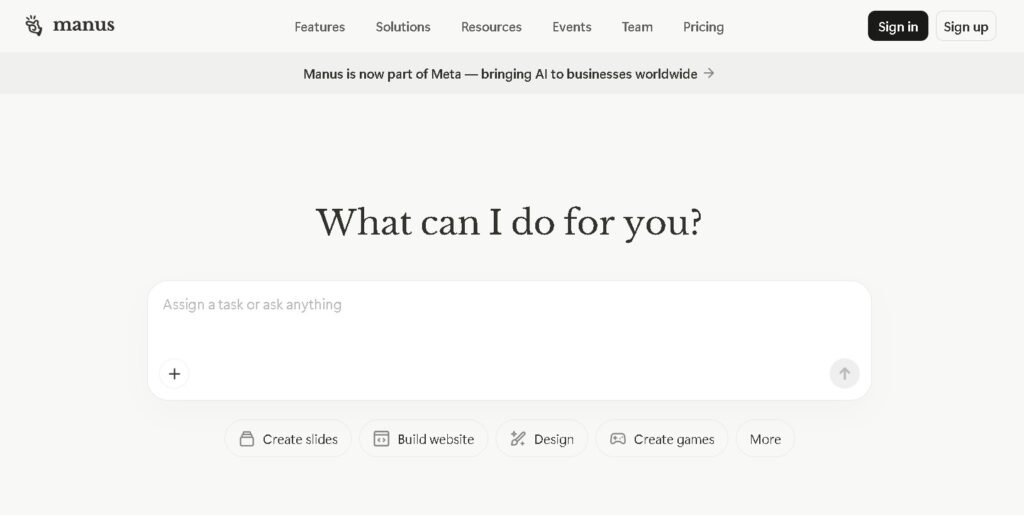
Manus’s website is clean and modern, with a simple prompt box front and center — similar in spirit to ChatGPT’s homepage. Signup is fast, and the free tier lets you start immediately without a credit card.
Dashboard
The dashboard displays running and completed tasks, credit balance, and generated files. Reviewers generally describe the interface itself as intuitive; the confusion tends to center on credit consumption, not navigation.
Speed
Task speed varies enormously by complexity — a simple slide deck can finish in minutes, while deep research or full app builds can run for an extended period.
Mobile Experience
Manus is primarily designed as a desktop/web experience; mobile use is possible through the browser but is not the product’s core design focus.
Ease of Use
Writing an effective instruction for Manus is genuinely easy — plain-English prompts work well. The harder skill is learning to scope tasks so they don’t consume more credits than expected.
Learning Curve
Low for basic use, moderate for cost-efficient use. Expect a few sessions before you develop a feel for which tasks are “cheap” versus “credit-expensive.”
Performance
Speed and Reliability
Manus can complete genuinely impressive multi-step tasks unattended, but public reviews and independent write-ups also describe inconsistent results on complex jobs and occasional task failures, particularly around website deployment.
Accuracy
Research-style outputs are generally well-regarded for depth. As with any AI agent, factual claims and code should still be independently verified before use in anything client-facing or production-critical.
Security
Granting an autonomous agent browser, terminal, and file access is inherently a larger trust surface than a standard chatbot. Users evaluating the desktop app’s “My Computer” feature in particular should weigh what local access they’re comfortable granting.
Scalability
Team and Enterprise tiers add shared credit pools, SSO, and admin controls, indicating the product is built to scale to organizational use — though the same credit unpredictability that affects individuals scales up for teams too.
Support Under Load
Several reviewers report that support responsiveness degrades noticeably once a dispute (typically billing-related) is raised, a pattern worth weighing before committing significant budget.
Customer Support
<a id=”customer-support”></a>
| Channel | Availability | Reported Quality |
|---|---|---|
| Yes | Reviewers describe unresolved issues persisting for months with a lack of communication</cite> | |
| Chat/Bot | Yes | Support has been described as handled by an AI bot that refuses escalation to a human and provides no case number |
| Phone | Not prominently offered | — |
| Knowledge Base / Help Center | Yes | Covers pricing and credit mechanics reasonably well |
| Response Time | Reported as slow for disputes | Multiple reviewers describe waiting weeks for resolution |
| Support Quality (disputes) | Reported as poor | A recurring theme across reviews is template responses rather than case-specific resolution |
Overall assessment: For straightforward usage questions, the Help Center is adequate. For billing disputes — the area users complain about most — support quality is a genuine weak point based on public reviews.
Trust & Safety
Company Transparency
Manus publishes its pricing and plan structure publicly, and its Help Center outlines credit mechanics. However, the gap between published policy and reported real-world billing experiences (see below) is a legitimate transparency concern raised repeatedly by customers.
Privacy and Data Protection
As with any cloud-based agent that browses the web and handles your files, consider what data you’re comfortable exposing to a third-party virtual computer — especially for the desktop app’s local file and terminal access.
Compliance
Team and Enterprise plans advertise SSO and admin controls, which are baseline requirements for organizational compliance needs, though Manus does not prominently publish detailed compliance certifications (e.g., SOC 2) in its public marketing at the time of writing. Verify current certifications directly with Manus if compliance is a requirement for your organization.
Corporate Structure Note
One reviewer specifically flagged that the company operates as “Butterfly Effect Pte Ltd” out of Singapore, which is a legitimate corporate structure but is worth knowing if you’re weighing consumer-protection recourse in a dispute, since protections vary by jurisdiction.
Is Manus AI Legit?
Yes — Manus AI is a real, functioning product built by a real, well-funded company with named founders, disclosed investors, and a public track record dating to March 2025. It reached meaningful revenue scale quickly enough to attract a multi-billion-dollar acquisition offer from Meta. This is not a fly-by-night operation or an app with no substance behind it.
“Legit” in the sense of “a real product that does what it claims” and “legit” in the sense of “a company whose billing practices won’t frustrate you” are two different questions, though — and the second one deserves its own honest section.
Is Manus AI a Scam?
No — but the pattern of complaints is serious enough that you should go in with clear eyes.
Manus AI is not a scam in the classic sense of a company that takes money and delivers nothing. It is a functioning product used by real customers who get real deliverables. However, a large volume of public reviews describes:
- Credits being deducted without a clear or verifiable explanation.
- Refund requests being denied, sometimes by an automated support bot with no escalation path.
- Pricing or plan terms reportedly changing without clear advance notice to existing subscribers.
- Referral/invitation credits being revoked over unspecified “fraud” concerns without evidence shared with the affected user.
One aggregator summarizing the pattern noted a Trustpilot score of 2.4 out of 5, reflecting what reviewers describe as poor customer care and a lack of accountability
Our take: Use Manus for lower-stakes exploration first — the free tier or the $20 tier — before committing meaningful budget. Screenshot your credit balance before and after significant tasks, and read Manus’s current refund policy directly on their site before purchasing add-on credits in bulk.
Customer Reviews Summary
We reviewed publicly available Trustpilot feedback for manus.im (150+ reviews) rather than inventing testimonials. Here is an honest, balanced summary of recurring themes — not verbatim quotes.
Common Positive Themes
- Users who stick to lighter, well-scoped tasks report genuine time savings on research and content generation.
- The autonomy itself — handing off a task and getting a finished result — is repeatedly cited as the standout capability when it works as intended.
Common Negative Themes
- Credit consumption complaints: reviewers frequently describe tasks burning far more credits than expected, sometimes due to the agent looping or repeating failed steps.
- Billing disputes: several reviewers describe being charged unexpectedly or having plan changes applied without clear notice.
- Refund difficulty: a recurring complaint is that refund requests are denied by automated support with limited or no human escalation.
- Deployment failures: some reviewers report websites or apps that function in the editor but fail once deployed live.
Public Sentiment vs. Verified Facts
To be clear about the distinction the Google Helpful Content guidelines call for: the negative themes above are public sentiment drawn from user-submitted reviews, not independently verified facts about Manus’s internal systems. We cannot confirm the specifics of any individual billing dispute. What we can confirm is that the volume and consistency of similar complaints across multiple review platforms is high enough to warrant caution from prospective buyers.
Manus AI Alternatives
If Manus’s pricing model or support reputation gives you pause, here are the leading alternatives as of 2026:
- ChatGPT Agent mode the strongest general autonomous agent option, included with a ChatGPT Plus subscription at $20/month.
- Genspark a multi-agent autonomous workspace starting around $19.99/month on an annual plan often described by users as shipping deliverables faster than Manus, while Manus is seen as going deeper on harder technical tasks.
- Devin (Cognition Labs) an autonomous software engineer specializing in coding, debugging, and deployment, aimed squarely at engineering teams rather than general tasks.
- Lindy.ai — better suited to business process automation than open-ended research or app building.
- Replit Agent ships full-stack apps from a goal description, strong on code execution but weaker on research-style tasks.
- OpenAI Operator an autonomous browser agent excellent at structured web tasks, gated to ChatGPT Pro at $200/month.
- AgenticSeek a privacy-first option that runs entirely locally on your own hardware, with no subscription or cloud dependency.
Manus AI vs Competitors: Comparison Tables
Pricing Comparison
| Tool | Entry Price | Billing Model |
|---|---|---|
| Manus AI | Free / $20 / $40 / $200 per month | Credit-based |
| Genspark | $24.99/month</cite> | Subscription + credits |
| ChatGPT Agent | $20/month (Plus) | Included in subscription |
| OpenAI Operator | $200/month (ChatGPT Pro) | Included in subscription |
| Devin | From $20/month (core), $500/month (team) | Compute-unit based |
Feature Comparison
| Feature | Manus AI | Genspark | ChatGPT Agent | Devin |
|---|---|---|---|---|
| General-purpose autonomy | Yes | Yes | Yes | No (coding only) |
| Builds full websites/apps | Yes | Partial | No | Yes (code-focused) |
| Deep research mode | Yes (Wide Research) | Yes | Yes | No |
| Desktop/local file access | Yes | No | No | Yes (dev environment) |
| Free tier | Yes | Limited | Yes (with ChatGPT free) | No |
| Transparent per-task cost | No | Partial | Yes (flat subscription) | Partial |
Pros & Cons Snapshot
| Tool | Biggest Pro | Biggest Con |
|---|---|---|
| Manus AI | Deep, hands-off task autonomy | Unpredictable billing, support complaints |
| Genspark | Faster deliverables, polished UX | Less depth on hard technical tasks |
| ChatGPT Agent | Simple, predictable pricing | Less specialized for app-building |
| Devin | Best-in-class coding autonomy | Expensive, narrow use case |
Winner by Category
- Best for research depth: Manus AI or Genspark (roughly tied)
- Best for predictable pricing: ChatGPT Agent
- Best for professional software engineering: Devin
- Best for privacy-conscious users: AgenticSeek
Who Is Manus AI Best For?
Best For
- Solo founders and researchers who want a hands-off agent for research, reports, and first-draft prototypes.
- Agencies exploring rapid MVP or landing-page generation, provided outputs are reviewed before going live.
- Users comfortable monitoring credit usage closely and starting on a low-cost tier first.
Who Should Avoid It
- Businesses that need guaranteed, predictable monthly costs.
- Anyone planning to deploy Manus-built websites or apps directly to production without a technical review step.
- Users who have low tolerance for support friction, given the volume of refund and billing complaints on record.
- Organizations with strict compliance requirements that need clearly published certifications up front.
Ratings Breakdown
| Category | Score (out of 10) | Rationale |
|---|---|---|
| Features | 8.5 | Genuinely broad and advanced feature set (Wide Research, Web App Builder, desktop control) |
| Pricing | 4.5 | Competitive sticker price undercut by unpredictable credit consumption |
| Support | 3.0 | Widely and consistently reported as slow and bot-gated for disputes |
| Ease of Use | 7.5 | Simple to start; harder to master cost control |
| Security | 6.0 | Reasonable for a cloud agent, but local file/terminal access warrants caution |
| Performance | 7.0 | Strong on research depth; inconsistent on deployment reliability |
| Value for Money | 5.0 | Undermined by billing complaints and lack of upfront task-cost visibility |
| Overall | 6.3 | A powerful agent held back by billing transparency and support issues |
Final Verdict
Manus AI earns its reputation as one of the most capable autonomous AI agents available in 2026. Its ability to take a single instruction and return a finished research report, slide deck, or working web app is a real, tangible step beyond chatbots. The founding team has genuine credibility, and the product’s growth — including catching the eye of Meta for a multi-billion-dollar acquisition — reflects real market demand.
At the same time, this review can’t responsibly ignore the volume and consistency of billing, refund, and support complaints documented publicly. If you decide to try Manus AI, start small: use the free tier first, watch your credit consumption on a couple of real tasks, and only scale up spending once you’re confident you understand how costs behave for your specific use case. If predictable pricing or fast support matter more to you than raw capability, a flat-subscription alternative like ChatGPT Agent may be the safer starting point.
Bottom line: Capable and legitimate as a product — proceed, but budget cautiously and read the current refund policy before you pay.
Frequently Asked Questions
1. What is Manus AI used for? Manus AI is used for autonomous, multi-step tasks such as market research, report writing, data analysis, slide deck creation, and building simple websites or web apps from a single instruction.
2. Is Manus AI free to use? Yes, Manus offers a free plan with 300 daily refresh credits and no credit card required, though it’s best suited to light, occasional tasks rather than heavy usage.
3. How much does Manus AI cost per month? Paid plans range from $20/month for the entry Pro tier up to $200/month for the top Pro tier, plus Team plans starting at $20 per seat per month.
4. Is Manus AI legit or a scam? Manus AI is a legitimate, functioning product from a real company, not a scam that takes money without delivering anything. However, it has a significant volume of customer complaints about billing transparency and refund handling that prospective users should weigh carefully.
5. Who owns Manus AI in 2026? Ownership is currently unresolved: Meta’s proposed 2025 acquisition of Butterfly Effect was blocked by Chinese regulators in April 2026 and is being unwound, with the founders reportedly exploring a buyback.
6. Who founded Manus AI? Manus was founded by Xiao Hong (CEO) along with co-founders Ji Yichao (chief scientist) and Zhang Tao (product director), under the parent company Butterfly Effect.
7. Is Manus AI Chinese? Butterfly Effect, the company behind Manus, was originally founded in Beijing in 2022, and later relocated its operational headquarters to Singapore in 2025.
8. What models does Manus AI use? Manus relies on Anthropic’s Claude models for core reasoning and fine-tuned Alibaba Qwen models for specialized tasks.
9. Does Manus AI have a mobile app? Manus is primarily a web and desktop product; it does not currently center its experience around a dedicated mobile app.
10. Can Manus AI build a full website? Yes, its Web App Builder creates full websites and apps with a database, Stripe integration, and SEO built in, though users have reported deployment reliability issues that make a manual review step important.
11. Is Manus AI better than ChatGPT? They serve different purposes: ChatGPT (with Agent mode) is a conversational assistant that can also act autonomously, while Manus is purpose-built around autonomous, multi-step task delivery. Manus tends to go deeper on end-to-end deliverables; ChatGPT tends to offer more predictable pricing.
12. What is Manus AI’s Trustpilot rating? Manus’s Trustpilot score has been reported around 2.4 out of reflecting a substantial number of billing and support complaints.
13. Can I get a refund from Manus AI? Manus’s Help Center outlines a refund policy, but numerous public reviews describe refund requests being denied or handled only through automated support without human escalation. Read the current refund terms directly on manus.im before purchasing.
14. What are the best alternatives to Manus AI? ChatGPT Agent mode and Genspark are commonly cited as the leading alternatives, alongside Devin for coding-specific work and AgenticSeek for a fully local, privacy-first option.
15. How does Manus AI’s credit system work? Every action — research, image generation, coding, slide creation — consumes credits based on task complexity. A single deep-research task can use 900 to 1,000-plus credits, and the exact cost isn’t shown before you run the task, which is a major source of user complaints.
16. Is my data safe with Manus AI? Manus runs tasks in a cloud-based virtual computer and, via its desktop app, can access local files and the terminal on your own machine. Evaluate what data and system access you’re comfortable granting, particularly for the local “My Computer” feature.
17. Does Manus AI offer team or enterprise plans? “>Yes, Team plans start at $20 per seat per month with a shared credit pool, SSO, and admin controls, with Enterprise pricing available by contacting Manus directly.
Conclusion
Manus AI is a genuinely capable autonomous AI agent that delivers on much of its core promise: hand it a goal, and it can independently research, build, and produce a finished result. That capability is real, and it’s a meaningful part of why the product grew so quickly and attracted a serious acquisition offer from Meta. But capability is only half the picture. The pattern of billing confusion, refund friction, and support complaints documented across public reviews is significant enough that it shouldn’t be an afterthought in your decision. Start on the free tier, understand your own usage patterns before scaling up spending, and weigh Manus against flat-priced alternatives if predictability matters more to you than raw autonomy. Make the choice that fits your risk tolerance and your budget — not just the hype.
Disclosure: If this article contains affiliate links, we may earn a commission at no extra cost to you. This does not influence our rating or the complaints we’ve documented above.
Gamma AI Review 2026: Amazing Results, Powerful Features & Honest Verdict
[…] Gamma Pricing […]
What Is Artificial Intelligence? How AI Works, Benefits & Examples
[…] probably use artificial intelligence more often than you […]